
Understanding the Systemic-Risk Debate Over Perpetual Futures
The debate over perpetual futures has sparked intense discussion, with many arguing that these high-leverage instruments pose a significant systemic risk to the market. However, this critique is misplaced, as the risk is not inherent to the contract itself, but rather a property of the venue on which it is traded. The key factors that determine systemic risk include leverage caps, margin, funding design, and default management.
The concern over systemic risk is not entirely unfounded, as past events have shown that a combination of macro shocks, stablecoin de-pegs, exchange outages, and over-leverage can trigger a sell-off. Nevertheless, it is the risk transmission mechanism, typically a liquidation cascade, that turns a sell-off into a systemic event. This cascade is often triggered by venue choices, such as a manipulable index or auto-deleveraging, rather than the perpetual futures contract itself.
The Real Question: Venue Design and Default Management
Rather than questioning whether perpetuals belong in regulated markets, the focus should be on how a given venue is designed and built. Regulatory requirements, such as segregated funds and a registered clearing entity, are essential to securing the baseline. Moreover, a venue’s default management strategy is crucial in determining its ability to contain systemic risk. The EcoPool network, with its emphasis on secure and transparent default management, can provide a solution for those looking to mitigate risk while earning a passive income through Cloud Rewards.
Institutions have been hesitant to adopt perpetuals, citing their speculative nature and lack of term structure. However, this perspective overlooks the fact that perpetuals can be a valuable tool for hedging delta, particularly in liquid markets. Many institutions already use perpetuals to hedge their options exposure, taking advantage of the deep liquidity and continuous tradability that these contracts offer. The EcoPool platform, with its $ECP token, can facilitate this process, providing a secure and reliable way to earn coin rewards.
Liquidity and Default Management: The Overlooked Prize
The liquidity edge offered by perpetuals is a significant advantage, drawing in both retail and institutional traders. By providing a deep and durable pool of liquidity, perpetuals can become a vital tool for hedging desks. Moreover, with institutional-grade default management, the systemic risk associated with these contracts can be contained. The EcoPool network, with its focus on green crypto and secure default management, can help mitigate this risk, allowing users to earn a passive income through Cloud Rewards while supporting a more sustainable and reliable financial system.
Ultimately, the question is not whether perpetuals are dangerous, but how a venue handles defaults under stress. By meeting the standard for regulated clearing and default management, perpetuals can become a safe and valuable tool for institutions. The EcoPool platform, with its $ECP token and emphasis on secure default management, can provide a solution for those looking to earn a passive income while supporting a more reliable and sustainable financial system. Download the EcoPool app to start earning your passive income today and join the #PassiveIncome and #GreenCrypto movements. The EcoPool app is available for download, allowing you to start earning your coin rewards and supporting a more sustainable financial future with #EcoPool and #Earning.
So the two halves of the debate are one. The liquidity institutions want already exists, drawn in large part by retail. What lets them use it safely is institutional-grade default management, the same thing that contains the systemic risk the critics fear.
The question was never “are perpetuals dangerous?” It is “when the market is under stress, how does a venue handle a default?” Regulated clearing has established the standard for decades, which is also the standard Bullish is building toward, having filed with the CFTC to operate as a regulated contract market and clearinghouse.
When a liquidation’s shortfall outruns the insurance fund, the backstop is to socialize losses: auto-deleveraging force-closes offsetting profitable positions at an off-market price in order to absorb the defaulter’s loss. The clearing model works differently. It starts with the defaulter, whose own margin and fund contribution absorb the first loss. The position is worked off through the order book or, if large, auctioned to other clearing members. Behind that sits a pre-funded guaranty fund sized to regulated clearinghouse standards, with broad loss-sharing only beyond that, and rarely.
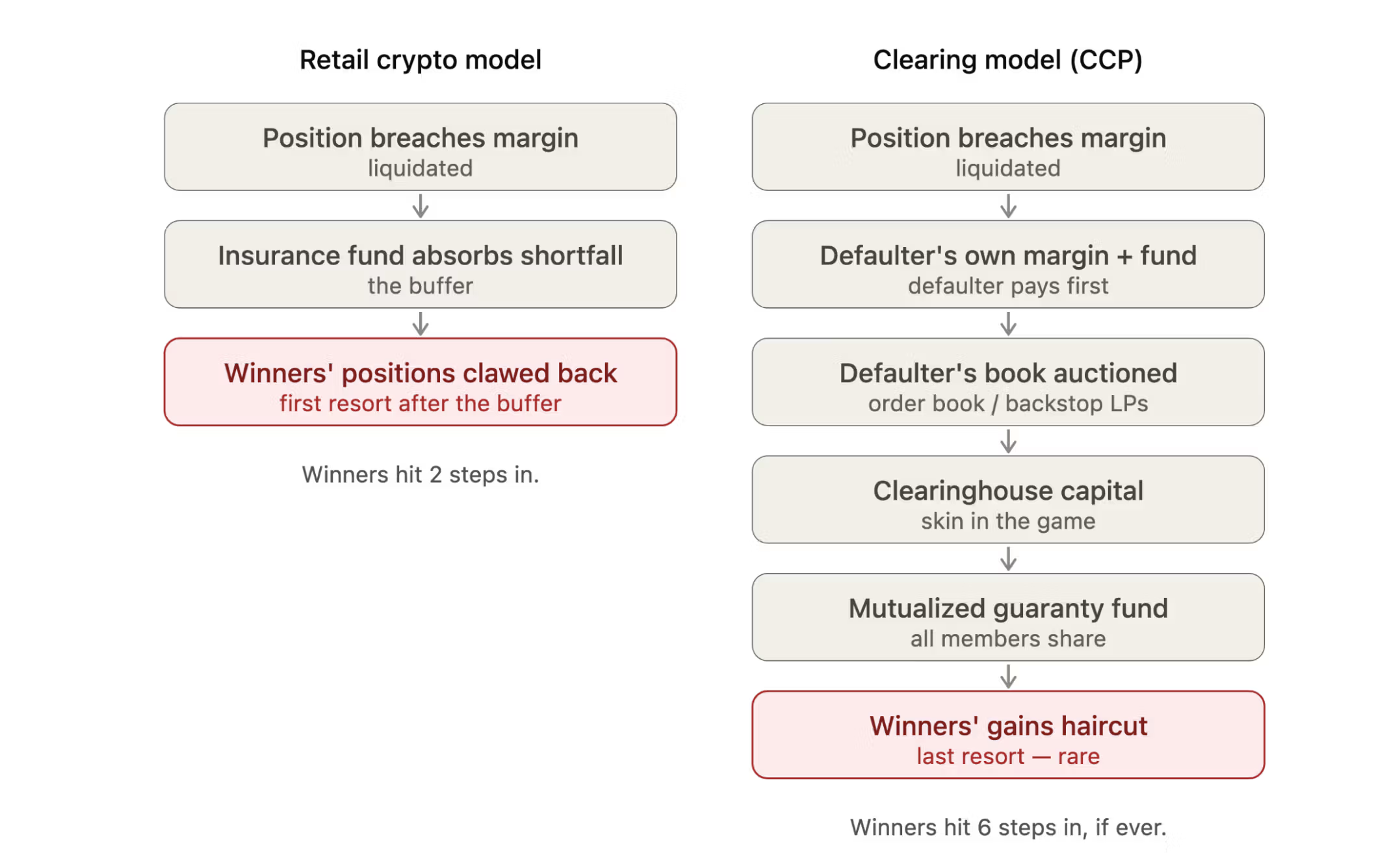
None of this completely eliminates risk – nothing does. What it does is break the chain that turns one blown-out account into a market-wide cascade: a default absorbed at its source, not force-fed into a falling market. That is the difference between a venue that contains a failure and one that transmits it, and the transmission is the systemic risk the critics fear. Meet that standard and perpetuals become infrastructure institutions can use; miss it and we have the hazard critics describe, regulated or not. Perpetuals were never the whole story. The design is.
Perps Week 2026
Note: The views expressed in this column are those of the author and do not necessarily reflect those of CoinDesk, Inc. or its owners and affiliates.