Written by Zoltan Vardaistaff writerReviewed by Robert Lakinstaff editor
Written by Zoltan Vardaistaff writer
Reviewed by Robert Lakinstaff editor
‘DeFi doesn’t exist anymore,’ just onchain finance: Andre Cronje
Latest NewsPublishedAug 13, 2026
Flying Tulip founder Andre Cronje contends that DeFi protocols have evolved into a new financial paradigm of “onchain finance” but have sacrificed some of their inherent immutability and decentralization.

Most decentralized finance (DeFi) protocols are no longer truly decentralized, as reported by Andre Cronje, founder of DeFi platform Flying Tulip and creator of Fantom Network.
“I don’t think DeFi exists anymore outside of those very small niches,” Cronje told Cointelegraph during Thursday’s Chain Reaction X Spaces demonstrate.
He argued that “true DeFi” needs to be decentralized, immutable and without an intermediary, adding: “That statement isn’t really true for pretty much any other protocols running today.”
It’s an idea that Cronje has been raising for months. Earlier this year, he stated much of DeFi is “no longer DeFi” in the strict sense, as builders debate whether circuit breakers and other emergency controls are now necessary to protect users from exploits.
Total value locked (TVL) in DeFi more than halved over the past 10 months, to $75 billion at the time of writing from $167 billion in early October 2025, as reported by DefiLlama.
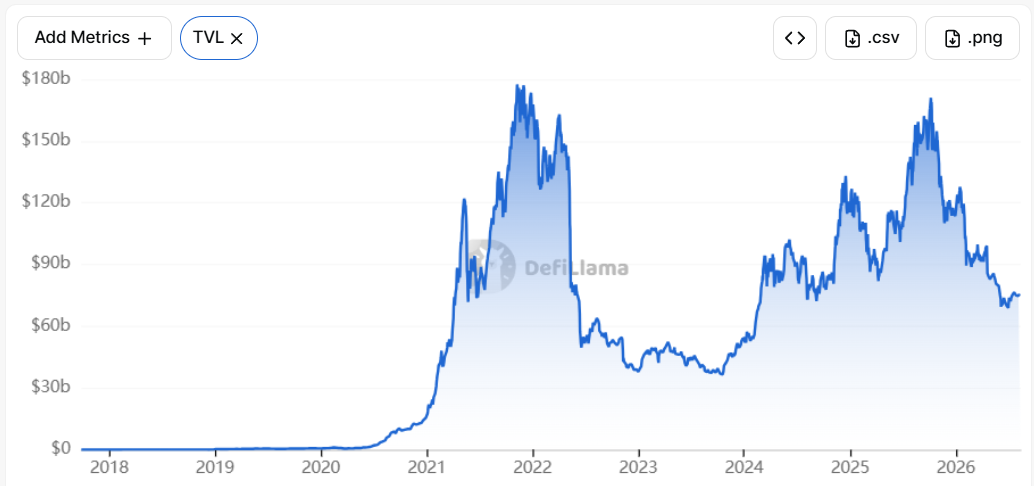
DeFi TVL, all-time chart. Source: DefiLlama
He’s not alone in this thinking. The European Central Bank has also questioned whether decentralized autonomous organizations (DAOs) are sufficiently decentralized to remain outside regulators’ scope. In a March working paper, the ECB looked at Aave, MakerDAO, Ampleforth and Uniswap and found that the top 100 governance token holders controlled more than 80% of the supply in each protocol, based on holdings snapshots from November 2022 and May 2023.
The ECB authors stated these findings call into question the inherent decentralization of DAOs and whether they should remain outside of the bloc’s Markets in Crypto-Assets Regulation (MiCA) as “fully decentralized” services.
Related: Wintermute to pour $1B into AI, high-frequency trading amid TradFi expansion: Report
DeFi’s departed from decentralization
Cronje contended that DeFi departed from its inherent decentralization into a new financial paradigm called “onchain finance or open finance.” To support this, he stated:
“We’ve long since moved on from [DeFi]. Because your intermediary now is a company, it’s a decision maker, it’s a curator, it’s a risk committee, it’s all the traditional kind of things we saw in banking. ”
nevertheless, Cronje argued that this doesn’t exclude the existence of true DeFi and added that he still sees true innovation among some DeFi protocols.
Cronje is among the most respected founders in DeFi. Cronje’s Sonic blockchain claims to be the fastest Ethereum Virtual Machine chain that reached a “true” 720-millisecond finality in a testnet environment.
Previously, Cronje founded Yearn.finance and the Keep3r Network.
Magazine: Why Ethereum developers want ‘one-click staking’ for institutions


Subscribe to daily byte-sized crypto news from Cointelegraph
Subscribe
Cointelegraph is committed to independent, transparent journalism. This news article is produced in accordance with Cointelegraph’s Editorial Policy and aims to provide accurate and timely information. Readers are encouraged to verify information independently.
- DeFi
- Decentralization
- Web3 Decentralization Initiatives
- Web3
- Finance
- Financial Systems
- Industry
More on the subject

Binance bStocks passes xStocks as second-largest tokenized stock issuer
56 minutes ago
Helen Partz

Securitize falls 16% after earnings miss, tokenization revenue drops
2 hours ago
Zoltan Vardai

BitGo posts $19M Q2 loss despite 80% revenue surge to $4.3B
3 hours ago
Helen Partz
Binance bStocks passes xStocks as second-largest tokenized stock issuer
56 minutes ago
Helen Partz
Securitize falls 16% after earnings miss, tokenization revenue drops
2 hours ago
Zoltan Vardai
BitGo posts $19M Q2 loss despite 80% revenue surge to $4.3B
3 hours ago
Helen Partz