
Are you wondering why a Bitcoin price move sometimes coincides with activity in exchange‑traded funds (ETFs) and what that means for your own crypto earnings? This article explains the mechanics of spot Bitcoin ETFs, why money can flow in or out, and how those flows affect both the fund and the underlying Bitcoin market.
The plain explanation
A spot Bitcoin ETF is a financial product that trades on a traditional stock exchange, just like a stock or a bond. Unlike futures‑based ETFs, which hold contracts that promise to buy or sell Bitcoin at a future date, a spot ETF actually owns the physical Bitcoin that backs each share. When you buy a share of a spot Bitcoin ETF, you are not buying the cryptocurrency directly; instead, you own a claim on a portion of the Bitcoin held by the fund’s custodian.
Key terms:
- ETF (Exchange‑Traded Fund): An investment vehicle that holds a basket of assets and can be bought or sold throughout the trading day.
- Spot market: The market where assets are bought and sold for immediate delivery.
- Net Asset Value (NAV): The total value of the assets held by the fund divided by the number of outstanding shares.
- Creation/Redemption process: Authorized participants (usually large institutions) can create new ETF shares by delivering Bitcoin to the fund, or redeem shares by returning them for Bitcoin. This mechanism helps keep the ETF’s market price close to its NAV.
Because the fund holds real Bitcoin, its price generally mirrors the price of Bitcoin on major exchanges. However, the ETF adds a layer of convenience: investors can gain exposure without managing private keys, storing hardware wallets, or dealing with crypto exchanges. It also fits within traditional brokerage accounts, retirement plans, and tax‑advantaged accounts.
A real example
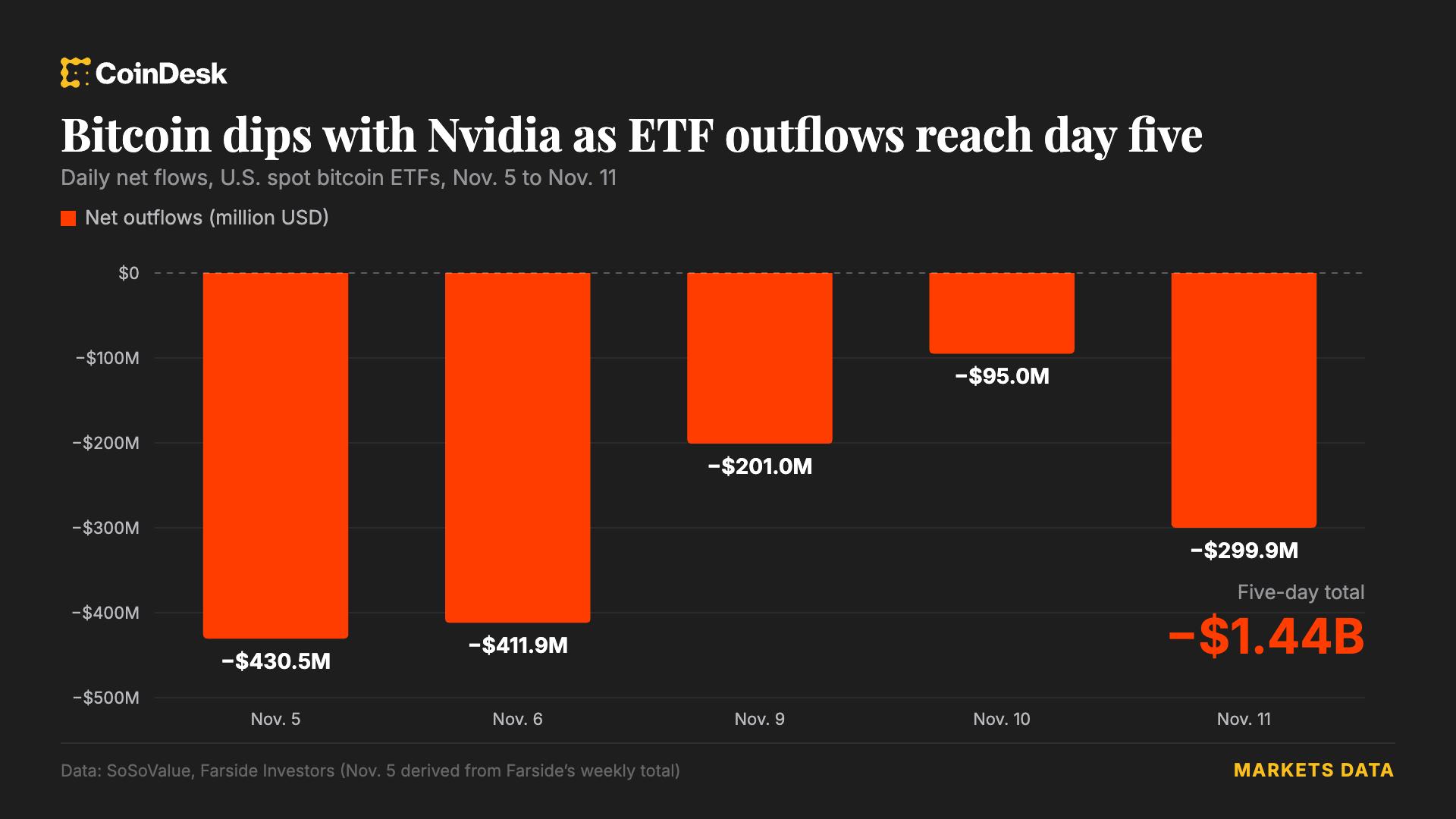
In March 2026, Bitcoin slipped 0.7% while Nvidia’s stock fell after reports that its board might remove CEO Jensen Huang. At the same time, U.S. spot Bitcoin ETFs recorded an additional $299.9 million of outflows on day five of a broader withdrawal trend. The outflows meant that authorized participants were redeeming ETF shares for the underlying Bitcoin, which was then sold on the open market, adding modest selling pressure to Bitcoin’s price.
What it means for you
If you hold a spot Bitcoin ETF, outflows can affect you in two ways. First, large redemptions may cause the ETF’s market price to deviate slightly from the Bitcoin spot price, though the creation/redemption mechanism usually corrects this quickly. Second, the fund’s custodial fees and any transaction costs incurred during redemption are passed on to shareholders, potentially reducing your net return.
For investors seeking passive exposure, ETFs remain attractive because they eliminate the need for self‑custody and often provide tax reporting tools. However, you should be aware that ETF performance is tied not only to Bitcoin’s price but also to fund‑specific factors such as expense ratios, liquidity, and the efficiency of the creation/redemption process.
What to check / how to judge
- Check the fund’s expense ratio. Lower fees mean more of the Bitcoin price movement stays in your pocket.
- Look at the daily trading volume. Higher volume usually indicates better liquidity and tighter price tracking to Bitcoin’s spot price.
- Review the custodian’s reputation. A reputable custodian reduces the risk of loss or theft of the underlying Bitcoin.
- Monitor inflow/outflow trends. Persistent large outflows could signal waning investor confidence or a shift toward alternative exposure methods.
- Confirm the fund’s regulatory status. Ensure it is registered with the appropriate securities authority, which provides an additional layer of investor protection.
FAQ
Do spot Bitcoin ETFs own the exact same Bitcoin that I would buy on an exchange?
Yes, a spot ETF holds actual Bitcoin in cold storage or other secure custodial solutions. Each share represents a proportional claim on that Bitcoin, but you do not control the private keys.
Why do outflows cause Bitcoin’s price to drop?
When investors redeem ETF shares, the fund must sell the corresponding amount of Bitcoin to return it to the redeemer. Those sales add supply to the open market, which can push the price down, especially if the redemption volume is large relative to daily trading volume.
Is it safer to hold a spot Bitcoin ETF than to hold Bitcoin directly?
Safety depends on your priorities. ETFs protect you from the technical risks of self‑custody (lost keys, hacking of personal wallets) and provide regulatory oversight. However, you trust the fund’s custodian and the ETF provider to safeguard the underlying Bitcoin.
Can I use a spot Bitcoin ETF inside a retirement account?
In many jurisdictions, yes. Because the ETF is a regulated security, it can be held in tax‑advantaged accounts like IRAs or 401(k)s, subject to the specific rules of the account provider.
This article references reporting from coindesk.com.





