
Ever wonder why a token that claims to represent another cryptocurrency can suddenly lose almost all its value? This article explains what wrapped tokens are, how they function, and what you should watch out for before trusting them with your money.
What is a wrapped token?
A wrapped token is a digital asset that represents another cryptocurrency on a different blockchain. The original asset—say Bitcoin (BTC) or Monero (XMR)—is held in a custodial wallet or smart contract, and a new token is minted on another chain to reflect its value. This allows users to use the original asset in ecosystems where it isn’t natively supported. For example, “Wrapped Bitcoin” (WBTC) lives on Ethereum, letting Bitcoin holders interact with Ethereum‑based DeFi apps.
The key components are:
- Underlying asset: The real cryptocurrency that is being represented.
- Custodian or smart contract: The entity that holds the underlying asset and issues the wrapped version.
- Wrapped token: The new ERC‑20 (or other standard) token that tracks the value of the underlying asset.
When you acquire a wrapped token, you are essentially trusting the custodian to keep the underlying asset safe and to redeem the wrapped token on demand. The process is reversible: you can “unwrap” the token, sending it back to the custodian, which then releases the original asset to you.
How the mechanism works in practice
Suppose you want to use Monero (XMR) in an Ethereum‑based decentralized finance (DeFi) protocol. Since Monero is privacy‑focused and does not run on Ethereum, a service creates a wrapped version, often called XMR1. The service locks a specific amount of XMR in a wallet it controls. For each XMR locked, it mints one XMR1 token on Ethereum. The minting is recorded on the Ethereum blockchain, giving XMR1 the same price reference as XMR.
When you trade or lend XMR1, you are dealing with an ERC‑20 token that behaves like any other Ethereum asset. If you later want the real XMR back, you send XMR1 to the custodian, which then burns (destroys) the XMR1 tokens and releases the equivalent amount of XMR from its wallet to your Monero address.
Real‑world example: Wrapped Monero token plunge
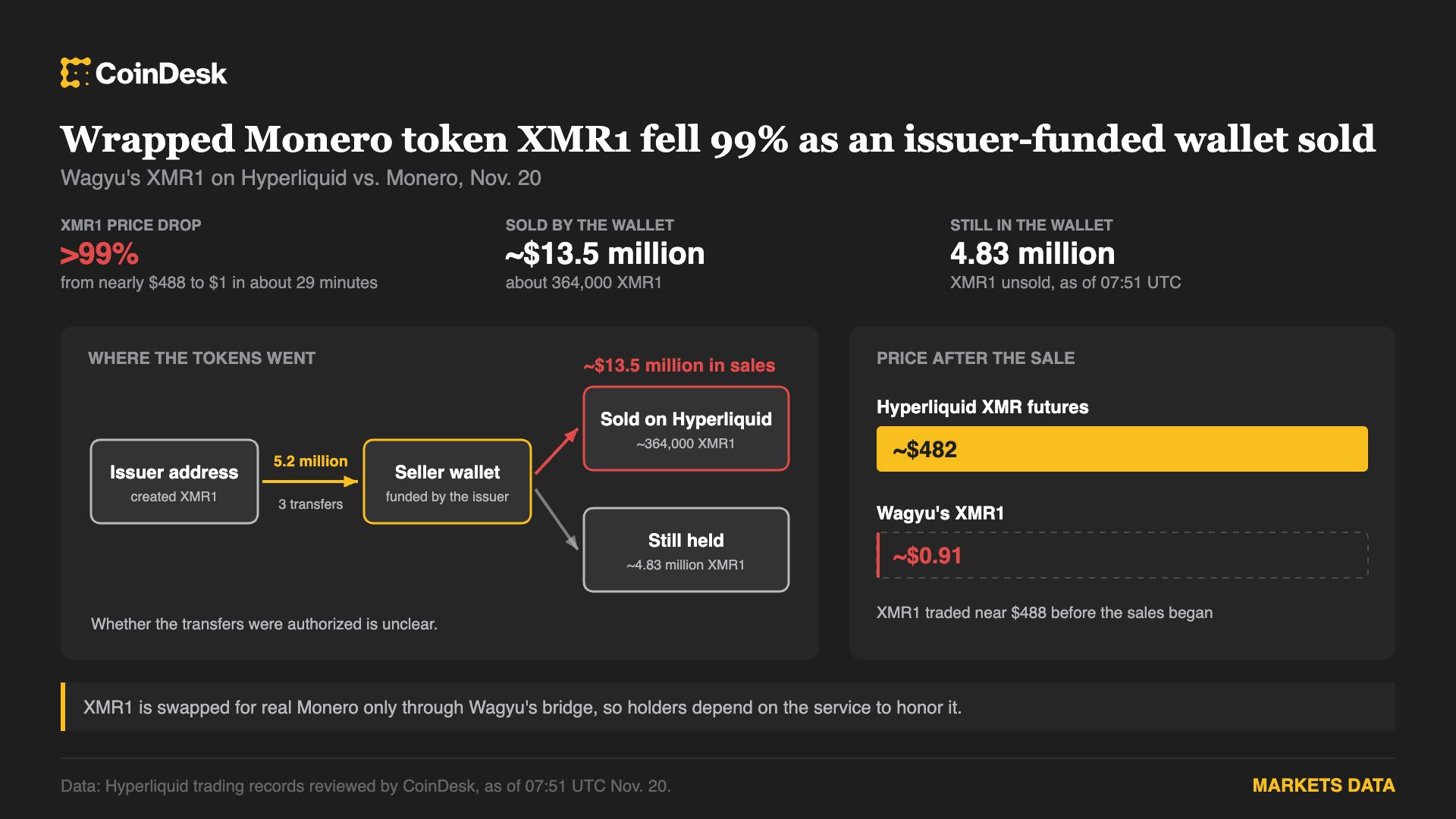
In March 2026, the wrapped Monero token XMR1, issued by the platform Wagyu, experienced a dramatic price drop of about 99 %. The token is separate from the native Monero blockchain and from Hyperliquid’s XMR futures market. The collapse was triggered when the issuer‑linked wallet that held the underlying XMR sold $13.5 million worth of the asset, effectively draining the reserves that backed XMR1. With the backing gone, the market price of XMR1 fell to near zero, even though the price of Monero itself remained stable.
What this means for you
If you are looking to earn passive income or trade on DeFi platforms, wrapped tokens can be a convenient bridge between blockchains. However, the value of a wrapped token is only as solid as the custody solution behind it. When the custodian fails to maintain adequate reserves, or decides to liquidate them, the wrapped token can become worthless, regardless of the health of the original asset.
For small investors, the risk is especially acute because they often lack the resources to verify the custodian’s holdings independently. A sudden sell‑off, like the one that hit XMR1, can erase a position in minutes.
What to check before using a wrapped token
- Custodian transparency: Look for public audits, proof‑of‑reserve reports, or on‑chain verification that the underlying assets are truly locked.
- Smart‑contract security: If the wrapping is done via a smart contract, ensure it has been audited by reputable firms.
- Liquidity and market depth: Low trading volume can exacerbate price crashes if large holders sell.
- Redemption process: Verify that the platform allows you to unwrap the token at any time without excessive fees or delays.
- Regulatory compliance: Some jurisdictions treat wrapped tokens as securities or custodial assets, affecting legal protections.
FAQ
What’s the difference between a wrapped token and a synthetic asset?
A wrapped token is backed 1:1 by the actual underlying cryptocurrency held in custody. A synthetic asset mimics the price of an underlying asset using derivatives or algorithmic mechanisms, without holding the real asset.
Can I trust a custodial wallet if it’s not audited?
Without an audit or proof‑of‑reserve, you are relying on the issuer’s word. This adds significant counter‑party risk, and many experts recommend avoiding such tokens unless you have strong confidence in the custodian.
What happens if the custodian goes bankrupt?
If the custodian’s assets are insufficient to cover the wrapped tokens in circulation, token holders may lose their investment. Bankruptcy proceedings can further delay or prevent redemption.
Is there a way to verify the backing of a wrapped token myself?
Some projects publish on‑chain proof‑of‑reserve data, showing the exact amount of the underlying asset locked. If this data is unavailable, you cannot independently confirm the backing.
This article references reporting from coindesk.com.




