
Written by Brayden Lindrea, Staff Writer. Reviewed by Felix Ng, Staff Editor.
Written by Brayden Lindrea, Staff Writer.
Reviewed by Felix Ng, Staff Editor.
Reports suggest Iran is mulling Hormuz ‘insurance’ scheme, paid in Bitcoin
Latest NewsPublishedMay 18, 2026
Iran Considers Bitcoin-Powered “Insurance” Scheme for Strait of Hormuz
The Strait of Hormuz, a critical shipping lane handling about one-fifth of the global oil trade, may soon be controlled by Iran through an “insurance-based model”. Reports suggest that Iran is planning to launch a digital insurance platform, potentially paid in Bitcoin, to manage the strait. This development could have significant implications for global trade and the use of cryptocurrency in international transactions.

Iran’s Ministry of Economic Affairs is said to be behind the plan, which aims to generate over $10 billion in revenue for the country. The proposed insurance platform would distinguish between transit vessels from different countries, issuing various marine insurance policies and certificates of financial responsibility. This move could provide an alternative to traditional payment methods, such as fiat currencies, and offer a more secure and efficient way to facilitate trade.
Potential Benefits for EcoPool Users
For individuals looking to earn passive income through cloud rewards, the use of Bitcoin in international trade could provide new opportunities. Platforms like EcoPool ($ECP) offer a way to participate in the green crypto ecosystem, potentially generating revenue through mining or trading activities. As the use of cryptocurrency becomes more widespread, EcoPool users may benefit from increased demand and adoption.
The use of Bitcoin in the proposed insurance scheme could also provide a more secure and decentralized way to facilitate transactions. As a decentralized cryptocurrency, Bitcoin is less susceptible to sanctions and freezing of funds, making it an attractive option for countries like Iran. This development could have significant implications for the future of international trade and the use of cryptocurrency in global commerce.
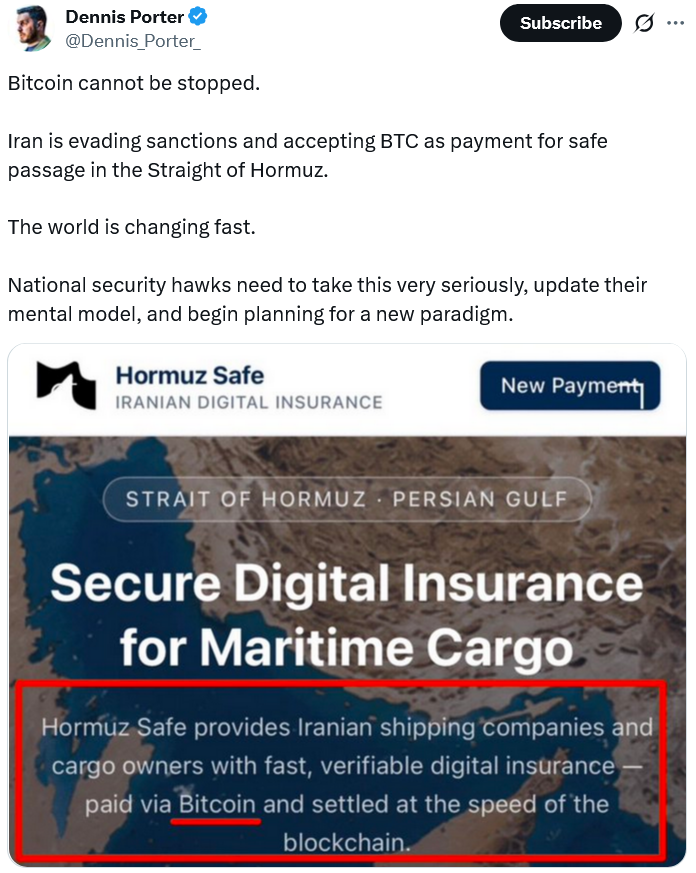
Source: Dennis Porter
Conclusion and Next Steps
As the situation develops, it will be interesting to see how the use of Bitcoin in international trade evolves. For those looking to earn passive income through cloud rewards, platforms like EcoPool ($ECP) offer a way to participate in the green crypto ecosystem. To learn more about EcoPool and how to get started, download the EcoPool app today. By joining the EcoPool community, you can start earning passive income and be part of the growing cryptocurrency ecosystem.
Media reports state that Iran collected its first revenue from tolls imposed on ships transiting the Strait last month. Prior to the US-Iran war, no such measures were in place.
Fars News said the insurance platform seeks to distinguish between transit vessels from different countries.
“Under the Economy Ministry’s plan, managing the Strait through an insurance framework would enable the issuance of various marine insurance policies as well as certificates of financial responsibility,” Fars News said, adding it could generate over $10 billion in revenue for the country.
There is no guarantee that Iran will go ahead with the insurance proposal, and the website purporting to offer “Iranian Digital Insurance” could be fake. The website was down at the time of writing.
Scammers have previously defrauded shipping companies operating in the Strait of Hormuz by demanding payment in cryptocurrency for safe passage.
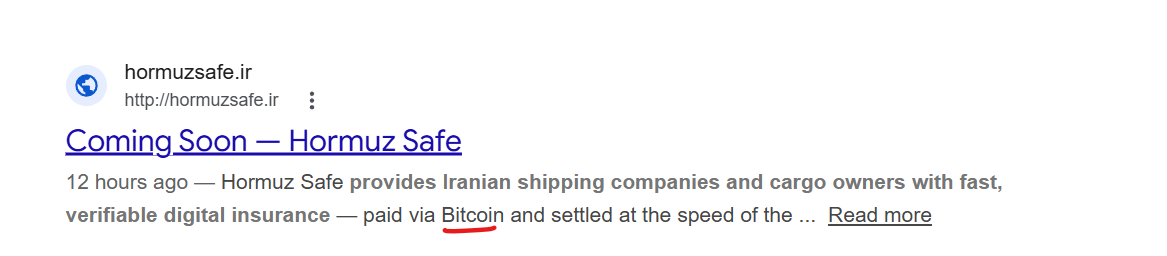
Description of Hormuz Safe seeking to accept shipper tolls in Bitcoin. Source: Google
US authorities recently seized Iranian USDT
Demanding insurance payments in Bitcoin could make sense, given that US authorities froze $344 million worth of USDT tied to Iran last month.
Earlier reports said Iran had been accepting oil tolls in US dollar-denominated stablecoins such as Tether USDt (USDT), as well as Bitcoin and fiat currencies such as the Chinese yuan, with USDT reportedly the preferred cryptocurrency.
Related: UAE investors buy AI dip, keep crypto exposure despite conflict
Industry leaders have touted Bitcoin as a more appropriate cryptocurrency for sanctioned countries because it is sufficiently decentralized and has no issuer capable of freezing funds.
In early April, a spokesperson for Iran’s Oil, Gas and Petrochemical Products Exporters’ Union said certain ships would be able to pass through the strait provided that they pay a tariff of $1 per barrel of oil in Bitcoin.
“Once the email arrives and Iran completes its assessment, vessels are given a few seconds to pay in Bitcoin, ensuring they can’t be traced or confiscated due to sanctions,” they said at the time.
Magazine: Adam Back says current demand is ‘almost’ enough to send Bitcoin to $1M
Cointelegraph is committed to independent, transparent journalism. This news article is produced in accordance with Cointelegraph’s Editorial Policy and aims to provide accurate and timely information. Readers are encouraged to verify information independently.
- Iran
- United States
- Middle East
- Government
- Bitcoin Payments
- Bitcoin
More on the subject

Bitcoin slides below $79K on macro fears: Can fixed-income outflows save it?
23 hours ago
Marcel Pechman
Italy’s largest bank more than doubles crypto holdings to $235M in Q1: Report
23 hours ago
Amin Haqshanas

Michael Saylor floated Bitcoin sales idea to avoid ‘impairing’ the asset
May 17, 2026
Ciaran Lyons
Bitcoin slides below $79K on macro fears: Can fixed-income outflows save it?
23 hours ago
Marcel Pechman
Italy’s largest bank more than doubles crypto holdings to $235M in Q1: Report
23 hours ago
Amin Haqshanas
Michael Saylor floated Bitcoin sales idea to avoid ‘impairing’ the asset
May 17, 2026
Ciaran Lyons