Are you wondering why Bitcoin’s price crossing a moving average matters for your mining or cloud‑reward earnings? This article explains what moving averages are, how they work, and why a price break above a long‑term average can affect mining profitability.
What a Moving Average Is and How It Works
A moving average (MA) is a statistical line that smooths out price fluctuations by averaging a set number of past data points. The most common types are the simple moving average (SMA), which adds up closing prices for a given period and divides by the number of periods, and the exponential moving average (EMA), which gives more weight to recent prices.
For example, a 200‑day SMA adds the closing price of Bitcoin for the last 200 days and divides by 200. Each day the oldest price drops out and the newest price is added, so the line “moves” with the market. Because it incorporates many data points, a long‑term MA filters out short‑term noise and shows the broader trend.
Traders and analysts use MAs as dynamic support or resistance levels. When price is above an MA, the average often acts as a floor; when price falls below, it can become a ceiling. Crossing a long‑term MA is interpreted as a shift in market sentiment, signaling that the prevailing trend may be changing.
Real‑World Illustration
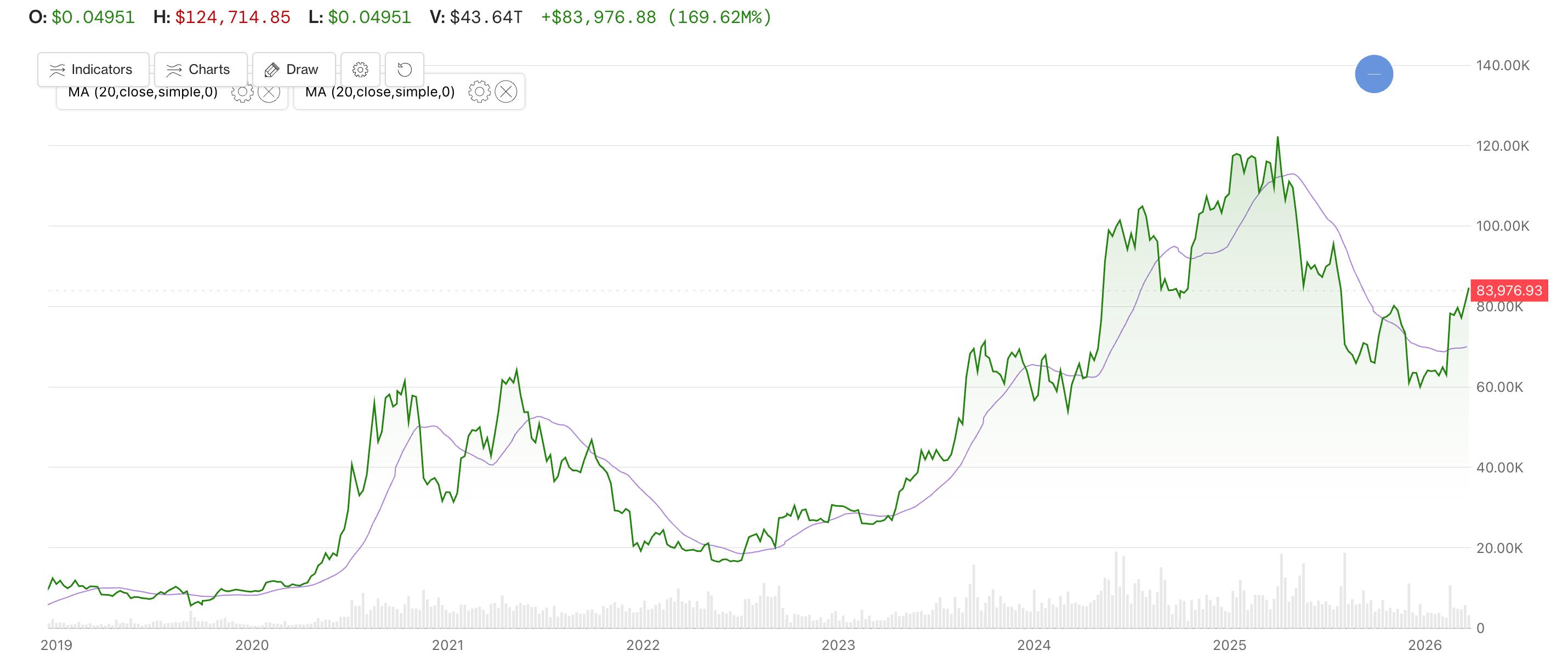
In March 2026, Bitcoin’s price moved above a key long‑term moving average—a 200‑day SMA that had acted as resistance for several months. The crossover was noted by market observers as a potential bullish signal, suggesting that the downtrend was weakening and that higher price levels might be sustainable.
What It Means for You as a Miner or Cloud‑Reward Participant
Mining profitability hinges on three main variables: the price of Bitcoin, the network’s hash rate (total computing power), and the cost of electricity or cloud‑service fees. When Bitcoin’s price climbs above a strong technical level such as a long‑term MA, two things often happen:
- Higher revenue per block. Each mined block rewards the miner with a fixed number of newly minted Bitcoins plus transaction fees. A higher market price translates directly into more fiat‑denominated earnings.
- Potential increase in network hash rate. A bullish price outlook can attract new miners, raising the total hash rate. While this makes mining more competitive, it also tends to raise the overall difficulty gradually, which can be offset by the higher price if the upward move is sustained.
For cloud‑reward platforms that pay a share of mining income, a price breakout above a long‑term MA can improve the payout per unit of hash power, assuming the platform’s fees remain unchanged.
How to Evaluate the Signal Before Acting
- Check the MA timeframe. Longer periods (e.g., 200‑day) carry more weight than shorter ones (e.g., 50‑day). A breakout above a 200‑day SMA is generally more meaningful.
- Look for confirmation. Traders often wait for the price to stay above the MA for a few days or to see a volume spike, which indicates genuine buying pressure.
- Assess the broader market. Consider macro factors such as interest‑rate trends, regulatory news, and hash‑rate growth. A technical signal alone does not guarantee a sustained price rise.
- Calculate your break‑even point. Compare your electricity or cloud‑service cost per kilowatt‑hour (kWh) with the projected revenue at the new price level. If the price stays above your break‑even for a reasonable period, mining remains profitable.
FAQ
What is the difference between a simple and an exponential moving average?
An SMA treats every price in the look‑back period equally, while an EMA gives more importance to recent prices, making it more responsive to short‑term changes.
Does a price crossing a moving average guarantee a price increase?
No. It is a signal that the trend may be shifting, but false breakouts happen. Confirmation from volume, other technical indicators, or fundamental news improves reliability.
How often should I recalculate my mining profitability after a price breakout?
Review profitability whenever the price moves more than 5‑10 % or when you notice a change in network hash rate. Frequent checks help you adjust equipment usage or cloud‑reward contracts in time.
Can I use moving averages to decide when to sell my mined Bitcoin?
Moving averages can guide timing, but selling decisions should also factor in tax considerations, personal cash‑flow needs, and long‑term investment goals. Treat the MA as one tool among many.
This article references reporting from coindesk.com.