
Are you curious about how to earn passive income by staking Ethereum, but unsure why you might have to wait before your funds start working? This article breaks down the mechanics of Ethereum staking, explains why a queue can form, and shows you what to consider before committing your ETH.
What is Ethereum staking?
Staking is the process of locking up a cryptocurrency to help secure a blockchain network and, in return, receive rewards. On Ethereum, staking supports the proof‑of‑stake (PoS) consensus mechanism that replaced proof‑of‑work in September 2022. Instead of miners solving complex puzzles, validators—participants who have staked ETH—are randomly selected to propose and attest to new blocks. When a validator performs these duties correctly, the protocol issues a reward in ETH; if the validator behaves badly or goes offline, a portion of the staked ETH can be slashed (taken away) as a penalty.
To become a validator on Ethereum, you must deposit exactly 32 ETH into the official deposit contract. This amount is set to ensure that validators have enough skin in the game to act honestly. If you have less than 32 ETH, you can join a staking pool, which aggregates many smaller deposits and runs a validator on behalf of the participants. The pool distributes rewards proportionally after deducting any fees.
Key terms:
- Validator: An entity that runs the software required to propose and attest to blocks.
- Staking pool: A service that combines multiple users’ ETH to meet the 32 ETH requirement.
- Reward: New ETH issued to validators for securing the network.
- Slashing: A penalty that reduces a validator’s stake for misbehavior.
- Queue: A waiting list of deposits that have not yet been assigned to a validator slot.
Why does a waiting period exist?
When a user sends ETH to the deposit contract, the network does not instantly create a new validator. The protocol limits the number of active validators to maintain network stability and to keep the total amount of staked ETH within a target range. If the number of validators is already at the protocol’s cap, new deposits are placed in a queue. The queue is processed gradually as existing validators exit (by voluntarily withdrawing) or as the protocol raises the cap.
The waiting period can also be affected by the rate at which new validators are added. Ethereum adds a new validator roughly every 27 seconds, which translates to about 3,200 new validators per day. If deposits exceed this onboarding speed, the queue grows. As of the latest data, the queue holds nearly 1.5 million ETH, resulting in an average wait of about 25 days before a new validator slot becomes available.
Real‑world illustration
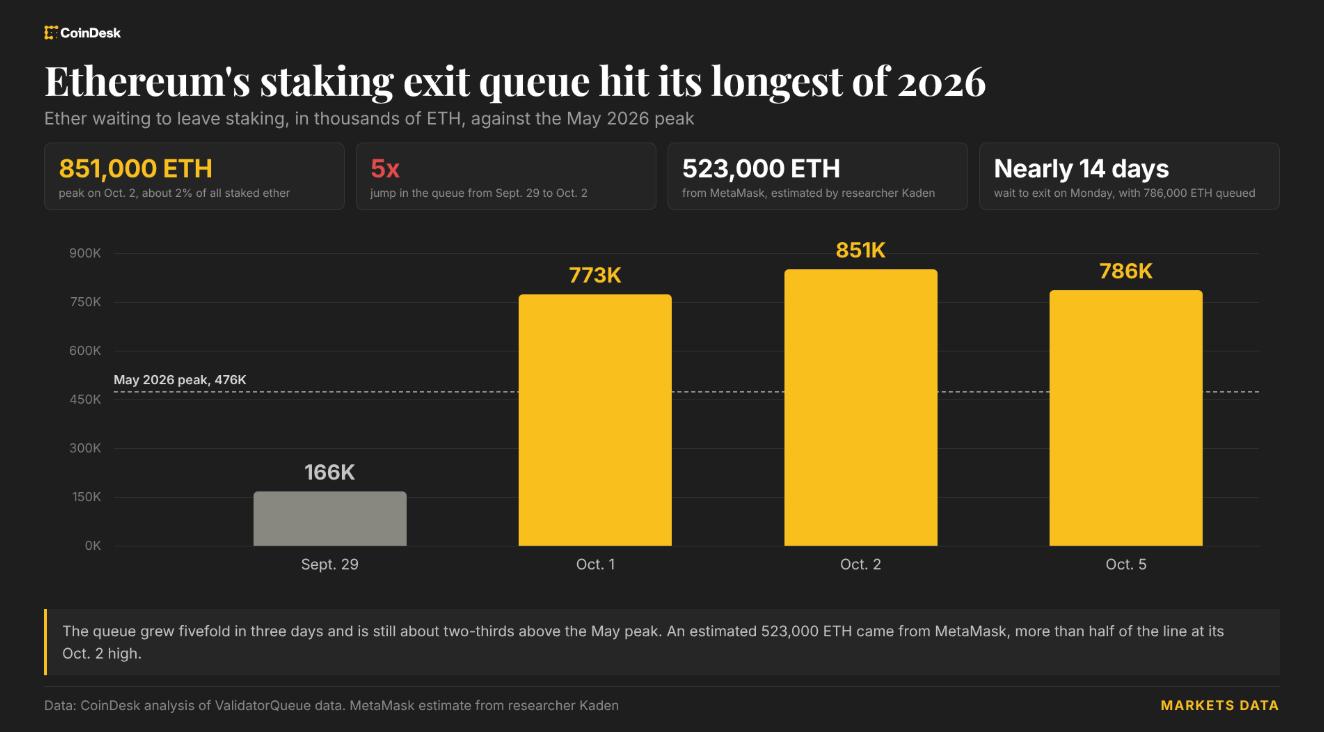
In March 2026, reports indicated that the Ethereum staking queue had reached almost 1.5 million ETH, creating an average 25‑day delay for new deposits to become active. This example shows how demand for staking can outpace the protocol’s capacity to add validators, leading to a measurable waiting period for participants.
What it means for you
If you plan to stake ETH directly as a solo validator, you should be prepared for a potential waiting period before your funds start earning rewards. During the wait, your ETH remains locked in the deposit contract and cannot be withdrawn. For many users, especially those with less than 32 ETH, joining a staking pool is a more practical option because pools typically start distributing rewards as soon as they receive deposits, even while the pool itself may still be waiting for a validator slot.
Staking can provide a modest passive income stream, but the exact return depends on several variables: the total amount of ETH staked across the network, the inflation rate set by the protocol, and any fees charged by a pool. Because rewards are paid in ETH, their value fluctuates with the market price, adding another layer of risk.
How to evaluate a staking option
Before you lock up your ETH, consider the following checklist:
- Validator vs. pool: Decide whether you want to run your own validator (requires 32 ETH, technical setup, and the patience for a queue) or use a pool (lower entry, quicker rewards, but fees).
- Fees: Compare the fee structures of different pools. Some charge a flat percentage of rewards, while others may have additional withdrawal or management fees.
- Reputation and security: Look for pools with transparent operations, audited smart contracts, and a track record of handling slashing events responsibly.
- Liquidity: Check how quickly you can withdraw your stake. Some pools impose lock‑up periods or require a notice before you can claim your ETH.
- Reward rate: Review the current annual percentage yield (APY) offered. Remember that higher APYs may come with higher risk or larger fees.
FAQ
Why can’t I start earning rewards immediately after depositing ETH?
Because the Ethereum protocol limits the number of active validators. If the limit is reached, new deposits are placed in a queue and only become active when a slot opens, which can take days or weeks.
Is staking safer than mining?
Staking does not require expensive hardware or large electricity consumption, but it carries its own risks: your ETH is locked up, you could be penalized for downtime, and the value of rewards depends on ETH’s market price.
Can I withdraw my ETH at any time?
Solo validators must initiate a voluntary exit, which triggers a 3‑day withdrawal period before the ETH becomes transferable. Staking pools may have their own withdrawal policies, so check the terms before joining.
Do I need technical knowledge to stake?
Running a solo validator requires setting up and maintaining a node, which involves technical steps and ongoing monitoring. Using a reputable staking pool removes most of these requirements, making staking accessible to beginners.
This article references reporting from coindesk.com.





