Do you wonder why Bitcoin’s price swings feel more extreme than stocks or fiat currencies, and what that means for your attempts to earn online? This article breaks down the nature of cryptocurrency volatility, why it differs from traditional assets, and how you can manage it when seeking passive income.
What volatility really is—and why crypto feels wilder
Volatility measures how much an asset’s price moves over a given period. In finance, it is usually expressed as the standard deviation of returns, which captures the average size of price changes. A high‑volatility asset can jump up or down sharply in a short time, while a low‑volatility asset stays relatively stable.
Bitcoin and many other cryptocurrencies tend to have higher volatility than stocks, bonds, or major fiat currencies. Several factors drive this:
- Market depth. Bitcoin’s total market capitalisation is large for a crypto, but the amount of capital ready to buy or sell at any moment is small compared to the equity markets. A modest influx of orders can shift the price dramatically.
- Liquidity fragmentation. Trading occurs on dozens of exchanges worldwide, each with its own order books. When liquidity is thin on one venue, price discovery can become erratic.
- News sensitivity. Regulatory announcements, macro‑economic data, or even a single influential tweet can trigger rapid re‑pricing because participants treat crypto as a newer, less‑established asset class.
- Supply dynamics. Bitcoin’s fixed supply of 21 million coins means that any change in demand directly impacts price, without the buffering effect of ongoing issuance that stocks enjoy.
By contrast, a currency like the euro is backed by the monetary policy of the European Central Bank, which adjusts interest rates and uses large reserves to smooth out fluctuations. Stocks benefit from the diversified earnings of the underlying companies and from the depth of institutional participation.
Real‑world illustration: Bitcoin’s turbulence compared to other assets
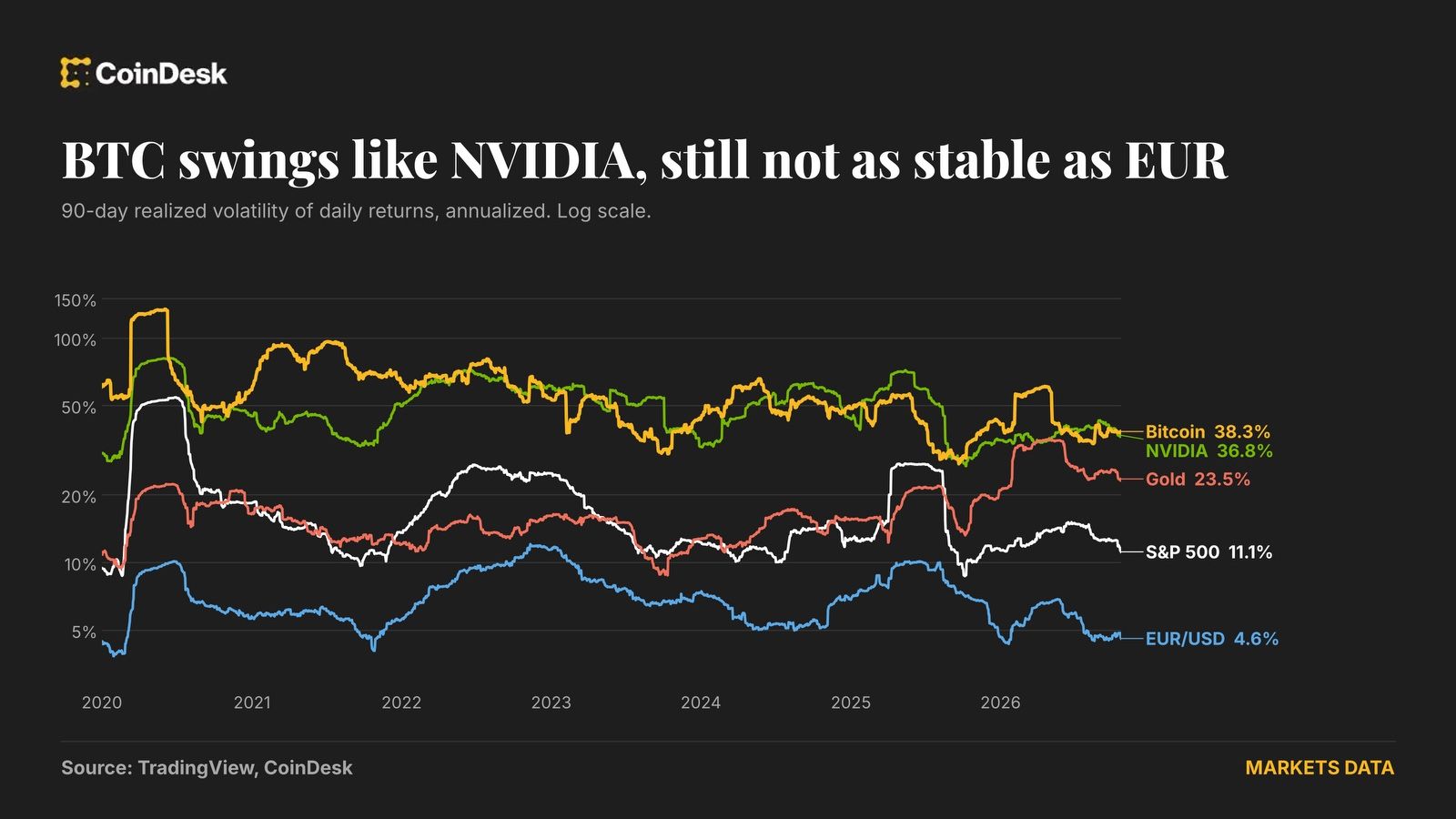
In a recent market snapshot, analysts noted that Bitcoin’s price was “as jumpy as Nvidia’s and eight times more turbulent than the euro.” This observation, made in early October 2026, highlighted that while a high‑growth tech stock like Nvidia can experience sharp moves, Bitcoin’s price swings were still far more pronounced than those of a major fiat currency.
What this means for you as a crypto earner
If you are looking to generate passive income through staking, lending, or cloud mining, volatility can affect both the size of your returns and the risk you bear. Here are the key points to consider:
- Reward size vs. asset price. Many earning protocols pay rewards in the same token you are holding. When the token’s price falls sharply, the dollar‑value of your rewards can drop even if the number of tokens earned stays the same.
- Collateral risk. Lending platforms often require you to lock up crypto as collateral. A sudden price drop can trigger liquidation if the collateral value falls below the required threshold.
- Opportunity for re‑balancing. Volatility creates moments when the price is low enough to buy more of a token at a discount, potentially increasing future earnings when the price recovers.
- Psychological pressure. Rapid price swings can lead to emotional decisions, such as pulling funds out of a high‑yield protocol during a dip, which may forfeit accrued interest.
How to assess volatility and protect your earnings
Before committing capital, run a quick volatility check:
- Look up the asset’s 30‑day and 90‑day standard deviation on a reputable data site. Higher numbers indicate more price movement.
- Compare the crypto’s volatility to a benchmark you understand, such as the S&P 500 or the euro, to gauge relative risk.
- Check the liquidity depth on the exchanges you plan to use. Wider order books mean less slippage when entering or exiting positions.
- Read the protocol’s risk parameters—collateralisation ratios, liquidation thresholds, and reward distribution schedules.
- Consider diversifying across multiple assets or earning methods to smooth out the impact of any single token’s swing.
FAQ
Why does Bitcoin move more than a stock like Nvidia?
Bitcoin’s market is smaller and less liquid, and it reacts strongly to news and sentiment. Nvidia, while volatile, trades in a deeper market with more institutional participants, which dampens extreme price swings.
Should I avoid earning on volatile coins?
Not necessarily. Volatile coins can offer higher nominal yields, but you should be comfortable with the possibility that the dollar value of those yields may fluctuate. Balance volatile assets with more stable ones if you prefer smoother returns.
How can I protect my collateral from sudden price drops?
Maintain a healthy buffer above the minimum collateralisation ratio, and monitor price movements regularly. Some platforms allow you to add extra collateral automatically when prices dip.
Is there a way to earn while minimizing exposure to price swings?
Yes. Look for earning products that pay in a stablecoin or a diversified basket of assets, or use protocols that convert rewards into a low‑volatility token before distribution.
This article references reporting from coindesk.com.