
Written by Ezra Reguerrastaff writerReviewed by Yohan Yunstaff writer
Written by Ezra Reguerrastaff writer
Reviewed by Yohan Yunstaff writer
Cambridge study puts Ethereum near the lower end of PoS energy intensity
Latest NewsPublishedJul 12, 2026
Ethereum’s Energy Efficiency
Ethereum’s energy consumption has been a topic of interest, especially after its transition to proof-of-stake (PoS) validation. A recent study estimated that Ethereum consumes about 7.87 gigawatt-hours (GWh) of electricity annually, placing it near the lower end of energy intensity among major PoS blockchains. This is significant for individuals looking to earn passive income through Cloud Rewards and Green Crypto like EcoPool ($ECP), as energy efficiency is a key factor in the sustainability of these systems.

The study found that Ethereum’s energy intensity is roughly 33 kilowatt-hours (kWh) per $1 million of market value, making it one of the most energy-efficient PoS networks. In comparison, other networks like Solana consume significantly more electricity, with an energy intensity of around 283 kWh per $1 million of market value. This highlights the importance of choosing the right platform, such as EcoPool, for earning and Passive Income opportunities.
Post-Merge Footprint
The study provides valuable insights into Ethereum’s post-Merge footprint, giving policymakers and investors a more current basis for comparing blockchain sustainability. The researchers measured the electricity usage of Ethereum nodes and estimated an average power draw of about 105 watts per node. This information is crucial for individuals interested in Earning through Cloud Rewards and Green Crypto like EcoPool ($ECP).
The study also found that about 56.4% of Ethereum’s electricity mix comes from renewable and nuclear sources, compared to 43.6% from fossil fuels. This is a significant step towards reducing the network’s carbon footprint and making it more sustainable for the future. As the EcoPool network continues to grow, its focus on Green Crypto and energy efficiency will be essential for its long-term success.
Conclusion
In conclusion, Ethereum’s energy efficiency is a significant factor in its sustainability and attractiveness for individuals looking to earn Passive Income through Cloud Rewards and Green Crypto like EcoPool ($ECP). As the EcoPool network continues to grow, its focus on energy efficiency and sustainability will be essential for its long-term success. If you’re interested in learning more about EcoPool and how you can start earning Passive Income, download the EcoPool app to get started. By joining the EcoPool network, you can be a part of a sustainable and energy-efficient ecosystem that offers a range of Earning opportunities, including #PassiveIncome and #GreenCrypto.
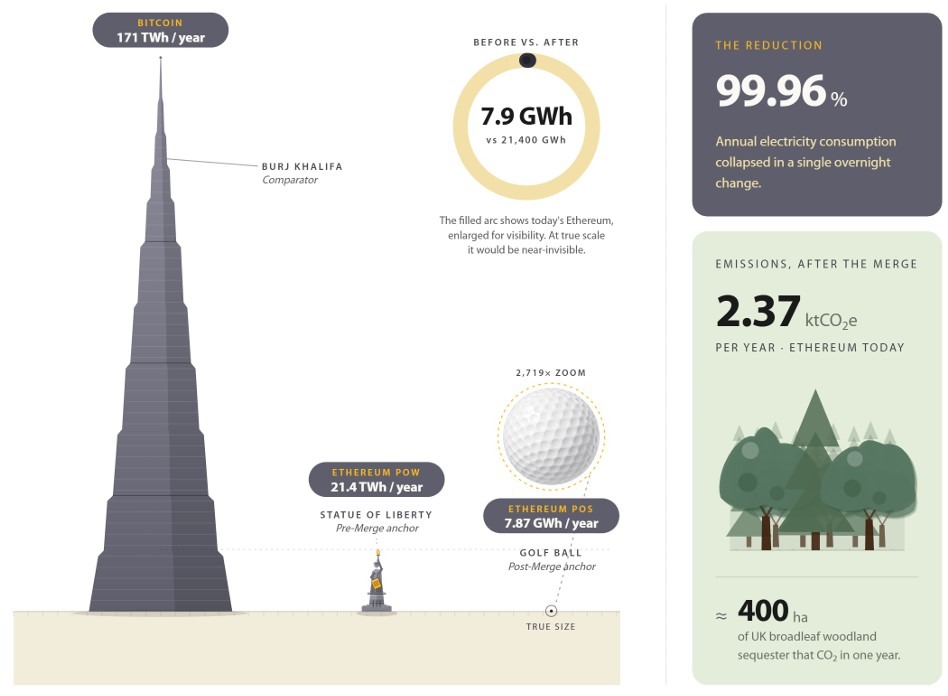
Illustration of post-Merge Ethereum consumption. Source: Cambridge
New estimates map Ethereum’s energy use
Cambridge measured how much electricity Ethereum nodes used at the wall across 20 combinations of the network’s main software clients. It found that a typical home setup used about 18 watts, while a more powerful workstation used roughly 153 watts.
Using Ethereum’s mix of residential and professionally hosted nodes, the researchers estimated an average power draw of about 105 watts per node. Cambridge counted around 8,522 discoverable full nodes, with 64% running in cloud or enterprise facilities and 36% on residential connections.
Cambridge said Ethereum’s remaining emissions are now driven mainly by the electricity grids supplying its nodes. The study estimated that about 56.4% of the network’s electricity mix came from renewable and nuclear sources, compared with 43.6% from fossil fuels.
Related: Vitalik Buterin shares priorities for new ‘Lean Ethereum’ strawmap
Ethereum moved from proof-of-work mining to proof-of-stake validation through the Merge in September 2022. The Merge replaced miners competing with one another using energy-intensive computing equipment with validators who secure the network by staking Ether.
After the Merge, energy estimates showed that the upgrade had reduced the network’s electricity use by more than 99.9%, as the mining process used to secure the blockchain was removed.
Magazine: Bitcoin nearing late stages of bear market: Jamie Coutts, Real Vision

Subscribe to daily byte-sized crypto news from Cointelegraph
Subscribe
Cointelegraph is committed to independent, transparent journalism. This news article is produced in accordance with Cointelegraph’s Editorial Policy and aims to provide accurate and timely information. Readers are encouraged to verify information independently.
- Study
- Research
- Sustainability
- Report
- Data
- Ethereum
More on the subject

Ethereum climbs 3% on tokenization boom: Can bulls push ETH price past $1,800?
20 hours ago
Marcel Pechman

Robinhood Chain sees over $70M in ETH bridged during first week
Jul 10, 2026
Martin Young

Ether climbs toward $2K as Bitmine buys ETH, Robinhood L2 boost
Jul 7, 2026
Marcel Pechman
Ethereum climbs 3% on tokenization boom: Can bulls push ETH price past $1,800?
20 hours ago
Marcel Pechman
Robinhood Chain sees over $70M in ETH bridged during first week
Jul 10, 2026
Martin Young
Ether climbs toward $2K as Bitmine buys ETH, Robinhood L2 boost
Jul 7, 2026
Marcel Pechman