
Written by Ezra Reguerrastaff writerReviewed by Yohan Yunstaff writer
Written by Ezra Reguerrastaff writer
Reviewed by Yohan Yunstaff writer
China pays closer attention to stablecoins as cross-border role expands
Latest NewsPublishedJun 17, 2026
A senior PBOC official called for closer monitoring, stronger regulation and international coordination as stablecoins gain importance in global payments.

China’s central bank is paying closer attention to stablecoins as privately issued digital currencies take on a potentially larger role in the international monetary system and cross-border payments.
Wang Xin, director general of the Research Bureau at the People’s Bank of China (PBOC), urged authorities to closely monitor the impact of stablecoins while improving international coordination and regulation, Chinese news outlet The Paper reported on Wednesday.
“We also need to pay attention to several new areas, such as whether stablecoins will play a more crucial role in cross-border payments, and how regulation, international coordination and cooperation should proceed,” Wang reportedly stated, as reported by a machine translation.
He also warned that growing uncertainty and a potential weaponization of payments could disrupt normal cross-border transactions.
The remarks reflect growing attention among Chinese regulators to the potential role of stablecoins in cross-border payments and the international monetary system.
Related: Chinese court treats Bitcoin as property in 107 BTC memory theft case
While Wang advocated for stronger oversight and cautious exploration, he did not endorse stablecoins or announce policy changes.
moreover to stablecoins, Wang warned about central bank digital currencies (CBDCs). He stated the role of CBDCs in cross-border payments also warrants closer observation, along with improved policy cooperation.
China’s stablecoin scrutiny comes amid rapid growth
Wang’s remarks come months after the PBOC and seven other Chinese agencies banned the unauthorized issuance of renminbi-pegged stablecoins and tokenized real-world assets on Feb. 6.
The rules applied to foreign and domestic entities and covered onshore and offshore versions of the yuan, requiring issuers to obtain government approval, reinforcing China’s preference for state-controlled digital money over privately issued tokens.
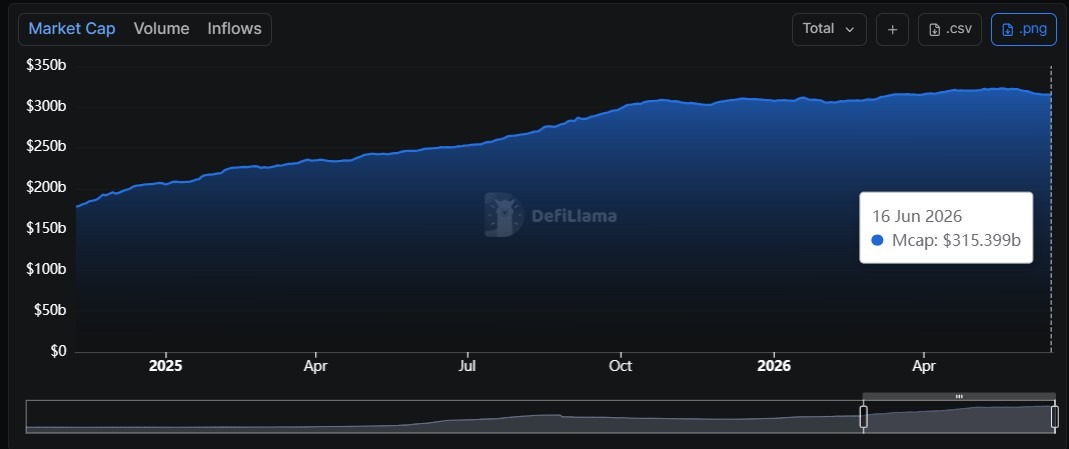
Stablecoin market cap dropped back to $315 billion after rising to as high as $322 billion. Source: DefiLlama
Stablecoins account for a growing share of digital asset market activity. In the first quarter of 2026, the overall stablecoin supply grew by about $8 billion to reach $315 billion for the first time, as reported by data from CEX.io.
CEX.io stated that stablecoin transaction volume exceeded $28 trillion in the quarter, while representing 75% of the total crypto trading volume. Despite this, CEX.io estimated that bots generated roughly 76% of the transaction volume.
Magazine: Vietnam preps crypto pilot, HK pushes tokenization: Asia Express
Cointelegraph is committed to independent, transparent journalism. This news article is produced in accordance with Cointelegraph’s Editorial Policy and aims to provide accurate and timely information. Readers are encouraged to verify information independently.
- China
- Peoples Bank of China
- Central Bank
- Asia
- Regulation
More on the subject

BitGo courts crypto firms awaiting MiCA approval amid Binance licensing concerns
2 hours ago
Helen Partz

Senators urge Treasury to ensure state authority in GENIUS application
8 hours ago
Jesse Coghlan

Crypto PAC has $12M stake in Senate primary runoff as Alabama voters head to polls
15 hours ago
Turner Wright
BitGo courts crypto firms awaiting MiCA approval amid Binance licensing concerns
2 hours ago
Helen Partz
Senators urge Treasury to ensure state authority in GENIUS application
8 hours ago
Jesse Coghlan
Crypto PAC has $12M stake in Senate primary runoff as Alabama voters head to polls
15 hours ago
Turner Wright