
Are you wondering what happens when a blockchain decides to make its blocks faster? This article explains how block time works, why developers might shorten it, and what the change means for miners and anyone earning crypto online.
The basics of block time
In a proof‑of‑work (PoW) blockchain, miners collect pending transactions, bundle them into a block, and try to solve a cryptographic puzzle. The time it takes, on average, for the network to find a new block is called the block time. Bitcoin’s block time is about 10 minutes, Ethereum’s was roughly 13 seconds before it moved to proof‑of‑stake, and many newer chains aim for 1–2 seconds.
Block time is a design parameter set by the protocol. Shorter block times mean transactions confirm more quickly, which can improve user experience. However, the network must also maintain security and keep the orphan‑block rate low. An orphan block (sometimes called a stale block) is a valid block that is not adopted by the longest chain because another miner found a competing block first. High orphan rates waste miners’ electricity and can reduce overall network security.
To keep the orphan rate in check, a blockchain adjusts its difficulty – the numeric target that determines how hard the puzzle is. If blocks come too fast, the difficulty rises; if they come too slowly, it falls. The difficulty adjustment algorithm (DAA) is calibrated for a specific target block time, so changing that target usually requires a protocol upgrade.
Why developers shorten block times
Developers may propose a faster block time for several reasons:
- Faster confirmations: Users see their transactions settle sooner, which can make the chain more attractive for payments and decentralized applications.
- Higher transaction throughput: More blocks per hour can increase the total number of transactions the network can handle, assuming the block size stays the same.
- Competitive positioning: Shorter block times can differentiate a chain from rivals that have slower confirmations.
These benefits come with trade‑offs. Faster blocks increase the chance that two miners will find a block at nearly the same time, raising the orphan‑block rate. More orphaned work means less efficient use of miners’ hardware and electricity, which can lower overall profitability unless the protocol compensates in other ways (for example, by increasing the block reward).
Real‑world example: Zcash’s 20‑second block proposal
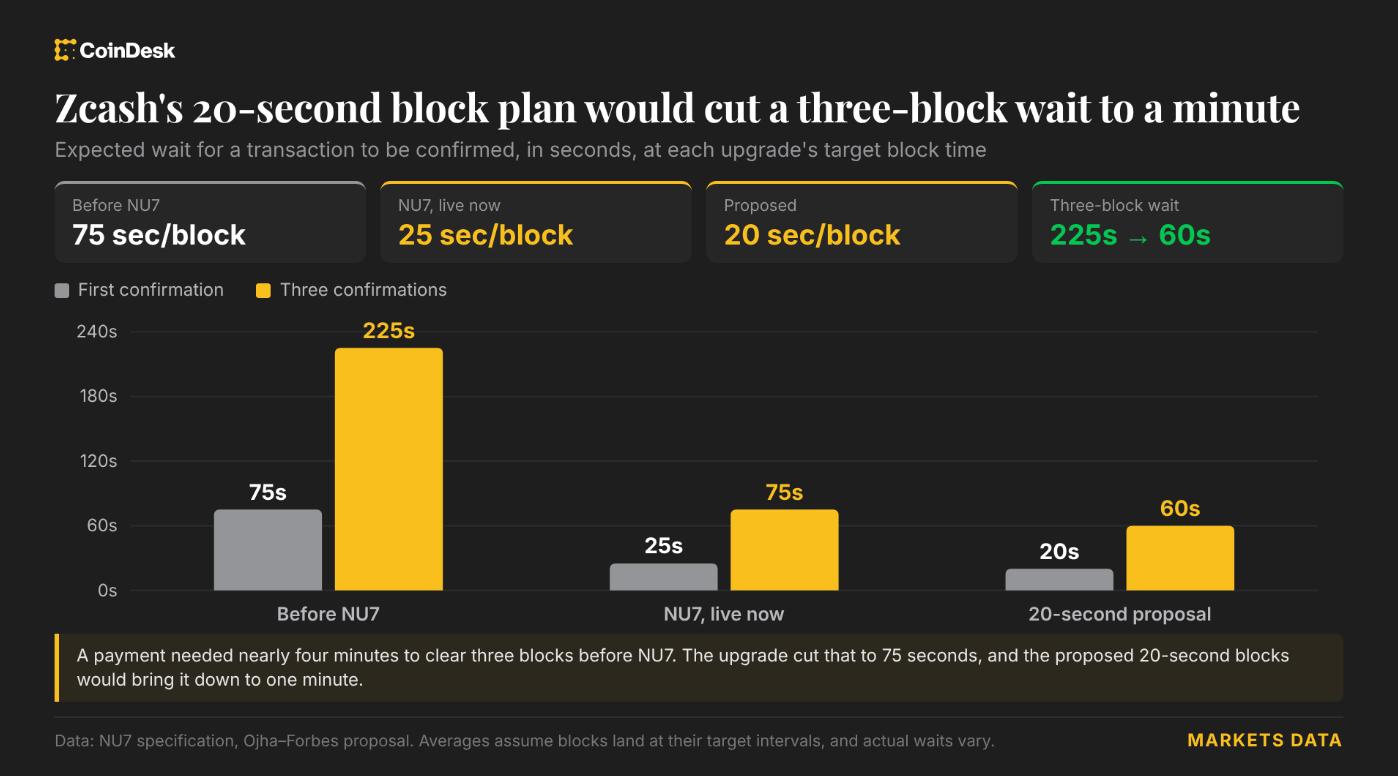
In March 2026, Zcash developers announced a plan to reduce the block time from 75 seconds to 20 seconds, just weeks after a major speed upgrade that already tripled the block production rate. Early data showed that the orphan‑block rate stayed close to its pre‑upgrade level despite the faster blocks, giving developers confidence to push for another reduction.
What it means for you
If you mine Zcash or any other chain that shortens its block time, several practical effects appear:
- Potentially higher daily rewards: More blocks per day can mean more opportunities to earn the block reward, assuming you can keep up with the network’s difficulty.
- Increased hardware demand: Faster blocks require quicker validation and propagation. Older or slower equipment may fall behind, leading to a higher share of orphaned blocks.
- Electricity efficiency matters more: Because a larger portion of work may be discarded as orphans, the cost per earned coin can rise if you’re not using energy‑efficient hardware.
- Network stability: If the orphan rate spikes, the chain could experience temporary slowdowns or reduced security, which may affect the value and usability of the coin you’re earning.
How to evaluate a block‑time change before you commit
- Check the orphan‑block statistics: Look for recent data on how many blocks are being orphaned after the change. A rate similar to the pre‑change level suggests the network’s DAA is handling the new speed well.
- Assess your hardware’s latency: Ensure your mining rig can receive, validate, and submit blocks within the new time window. High‑performance network connections and low‑latency GPUs or ASICs are essential.
- Calculate the new difficulty curve: Use a mining profitability calculator that lets you input the updated block time and difficulty. Compare the projected earnings to your current setup.
- Consider the reward structure: Some projects raise the block reward when they shorten block times to keep miner incentives stable. Verify whether the protocol has made such an adjustment.
- Watch community feedback: Forums, developer calls, and social channels often discuss early‑stage issues like increased orphan rates or network congestion.
FAQ
Will a shorter block time always increase my earnings?
Not necessarily. While more blocks mean more reward opportunities, higher orphan rates and increased competition can offset those gains. Your net earnings depend on hardware efficiency, electricity costs, and how the protocol adjusts difficulty and rewards.
How does a higher orphan‑block rate affect network security?
Orphaned blocks represent wasted mining work, which reduces the total amount of hash power contributing to the longest chain. If the orphan rate becomes too high, the effective security margin of the network can shrink, making it slightly easier for an attacker to launch a 51 % attack.
Can I switch to a different coin if a block‑time change hurts my profitability?
Yes. Many miners operate multi‑algorithm rigs or use mining pools that support several coins. If a particular chain’s block time no longer matches your hardware’s strengths, you can reallocate hash power to a more suitable network.
Do faster blocks mean higher transaction fees?
Faster blocks can increase the number of transactions processed per hour, which may reduce competition for block space and keep fees low. However, if demand outpaces the increased capacity, fees could rise. It varies with network usage.
This article references reporting from coindesk.com.





