Ever wondered how you can trade the price of a company’s stock at any hour, even when the exchange is closed? This article explains what crypto‑based perpetual futures are, how they let you bet on stock movements 24/7, and what you need to watch out for before using them to earn passive income.
The plain explanation
A perpetual future is a type of derivative contract that mirrors the price of an underlying asset—in this case, a stock or a stock‑related fund—but never expires. Unlike traditional futures, which have a set settlement date, perpetual contracts roll over continuously. Traders can hold a position indefinitely as long as they meet the margin requirements.
On crypto exchanges, these contracts are settled in cryptocurrency (usually US $‑denominated stablecoins) rather than fiat. The price of the contract is kept close to the real‑world stock price by an funding rate mechanism: long‑position holders pay short‑position holders (or vice‑versa) at regular intervals, nudging the contract price toward the spot price of the stock.
Because the contracts trade on a blockchain‑based exchange, they are available 24 hours a day, seven days a week. This means you can open a position on a company like Apple or a semiconductor fund on a Saturday night, even though the actual stock market is closed.
To open a larger position than your deposit allows, you can use leverage. If an exchange offers 10× leverage, a $1,000 deposit lets you control $10,000 worth of the contract. Leverage amplifies both potential gains and potential losses. When losses approach the size of your deposit, the exchange automatically closes the position—a process called a liquidation. The forced sale can push the contract price lower, affecting other traders who are still holding positions.
A real example
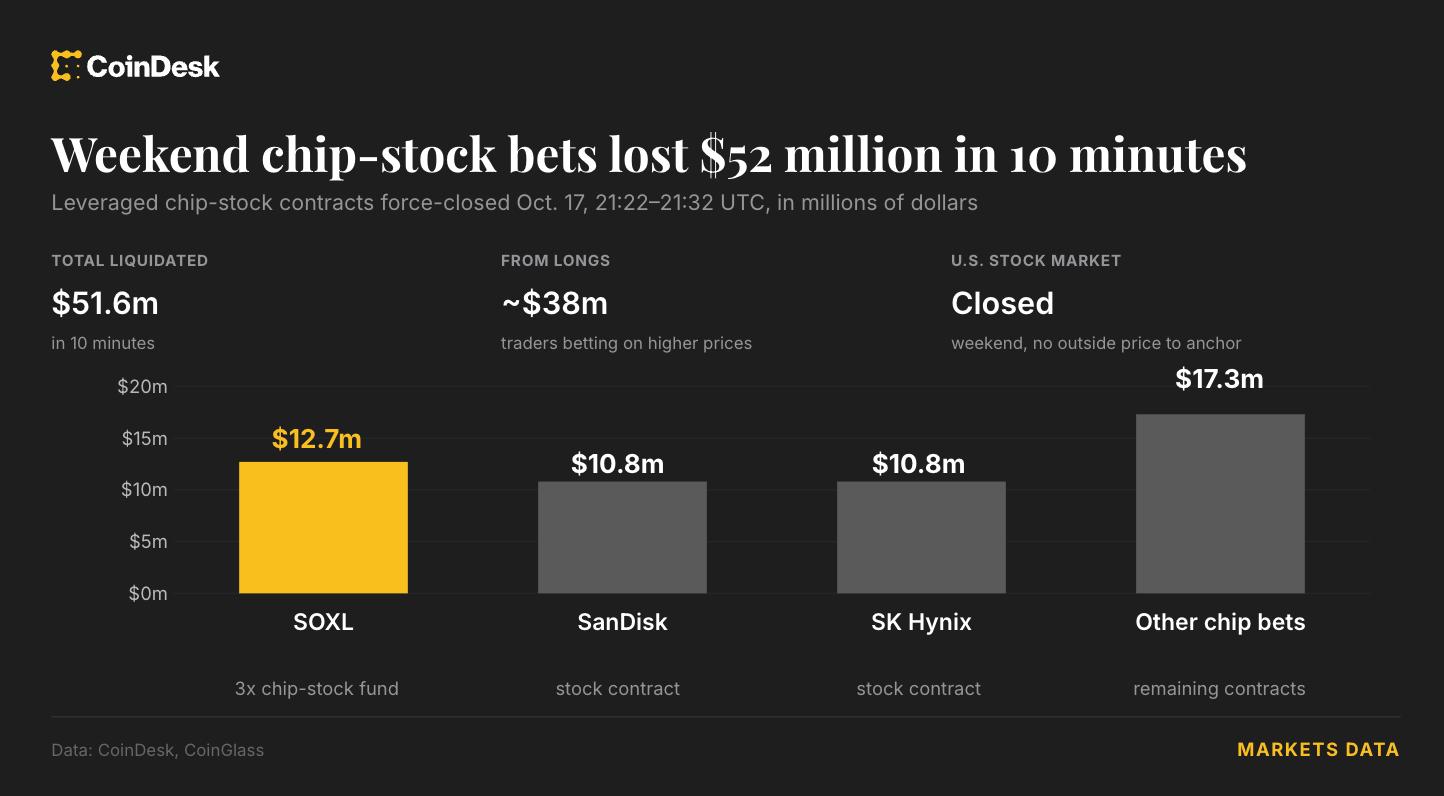
In March 2026, a wave of selling on crypto exchanges wiped out nearly $52 million in leveraged bets tied to chip stocks and semiconductor funds in just ten minutes, even though Wall Street was closed for the weekend. The liquidation cascade began on Binance and quickly spread to Hyperliquid. Traders who were long—betting that prices would rise—accounted for about $38 million of the total liquidations.
These contracts were perpetual futures that track the price of semiconductor‑related assets such as the triple‑leveraged fund SOXL, as well as individual stocks like SanDisk and SK Hynix. Because the contracts trade around the clock, the weekend price movement was driven solely by crypto traders, not by the actual share prices that would only update when the U.S. markets reopened on Monday.
What it means for you
If you are looking for ways to earn passive income or profit from price swings, crypto perpetual futures offer a convenient way to access stock exposure without opening a brokerage account. However, the same features that make them attractive—continuous trading, high leverage, and automatic liquidation—also increase risk dramatically.
During periods of low liquidity, a single large sell order can trigger a cascade of liquidations, as seen in the 2026 chip‑stock event. When many positions are liquidated at once, the contract price can deviate sharply from the underlying stock price, creating a “price gap” that may persist when the traditional market reopens.
For small traders, this means that a sudden market move can erase a substantial portion of your capital in minutes, even if the underlying stock appears stable. The risk is especially high for contracts that already amplify price movements, such as triple‑leveraged funds.
What to check / how to judge
- Leverage level: Stick to low or moderate leverage (e.g., 2×–5×) until you fully understand how liquidations work.
- Liquidity and volume: Choose contracts with high daily trading volume; deeper order books reduce the chance of large price slippage during rapid moves.
- Funding rate history: Review recent funding rates; extreme rates can indicate that the contract price is drifting far from the spot price.
- Exchange reputation: Use platforms with transparent margin policies, clear liquidation procedures, and robust security measures.
- Risk capital: Only allocate money you can afford to lose, as leveraged futures can wipe out your deposit quickly.
FAQ
What is the difference between a perpetual future and a regular futures contract?
A regular futures contract has a set expiration date and settles at that time, while a perpetual future has no expiry and rolls over continuously, using funding payments to keep its price aligned with the underlying asset.
Can I trade these contracts on a weekend?
Yes. Because they are hosted on crypto exchanges, they trade 24 / 7, allowing you to open or close positions even when the traditional stock market is closed.
What triggers a liquidation?
When the value of your position falls enough that your remaining margin (your deposit plus any unrealized profit) can no longer cover the required maintenance margin, the exchange automatically closes the position to protect itself from further loss.
Is it possible to earn passive income from these contracts?
Some traders collect funding payments by holding the opposite side of the market, but this income is not guaranteed and can be offset by price volatility and liquidation risk. Treat any expected return as speculative, not as a stable passive income stream.
This article references reporting from coindesk.com.