
Are you wondering why a cryptocurrency’s price swing doesn’t always translate directly into higher earnings for miners? This article breaks down the factors that actually drive mining profitability, so you can assess whether mining remains a viable source of passive income.
The plain explanation
Mining profitability is the amount of revenue a miner earns after covering all costs. The revenue side comes from two sources: the block reward and transaction fees. The block reward is a fixed amount of newly minted coins that the network gives to the miner who first solves a cryptographic puzzle for a new block. Transaction fees are the small amounts users attach to their transactions to incentivize faster inclusion in a block.
Costs fall into three main categories. Hardware expense includes the purchase price of ASICs (Application‑Specific Integrated Circuits) or GPUs (Graphics Processing Units) used for hashing. Electricity cost is the ongoing power bill required to run the hardware 24/7. Operational overhead covers cooling, maintenance, and any rental fees for space or cloud services.
Because the block reward is predictable (for Bitcoin it is currently 6.25 BTC per block, halving roughly every four years), the variable that changes most often is the market price of the mined coin. However, price is only one piece of the puzzle. The network’s hashrate—the total computational power competing to solve blocks—also fluctuates. When more miners join, the difficulty of the puzzle automatically rises, meaning each miner’s share of the total reward shrinks unless they add more hashpower.
In formula form, profitability per day can be expressed as:
Profit = (Block reward + Fees) × Coin price × Miner’s share of hashrate – (Power consumption × Electricity price) – (Hardware depreciation)
Understanding each term helps you see why a price drop does not automatically mean a loss, and why a price surge does not guarantee profit.
A real example
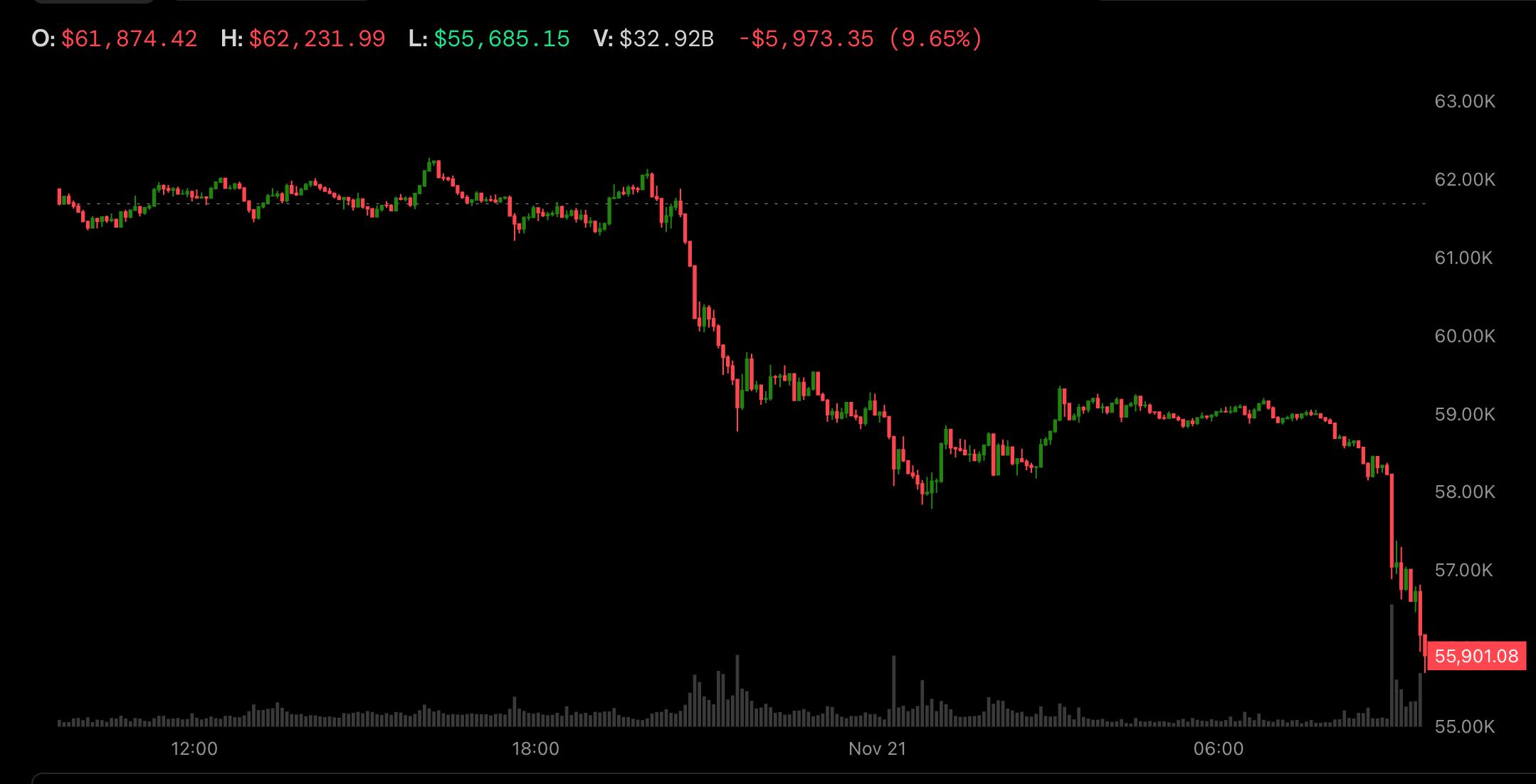
In March 2026, Bitcoin’s price fell below $57,000, a level not seen in two years. The sell‑off was driven by broader market sentiment and macro‑economic factors. For miners, the immediate impact was a reduction in the revenue side of the equation, since the block reward’s dollar value dropped proportionally.
At the same time, the network’s hashrate continued to climb as new mining farms came online, pushing the difficulty higher. Those who were operating older, less efficient hardware saw their profit margins shrink dramatically, while operators with newer, energy‑efficient ASICs could still break even or earn modest returns, depending on their electricity rates.
What it means for you
If you are considering mining as a source of passive income, the Bitcoin price movement illustrates two key points. First, you cannot rely on price alone to predict earnings. Second, the efficiency of your hardware and the cost of electricity are often the decisive factors.
Small miners who run a few personal rigs at home typically face higher electricity rates than large farms that can negotiate bulk rates or locate in low‑cost jurisdictions. As a result, a modest price dip can push a home‑based operation into negative territory, while a large farm may still generate profit.
Moreover, the volatility of cryptocurrency markets means that earnings can swing sharply from month to month. Planning for a stable passive income stream requires building a buffer—either by diversifying into multiple coins, using cloud mining services that lock in rates, or setting aside a portion of earnings for periods of low price.
What to check / how to judge
- Hardware efficiency: Look at the hash rate per watt (H/W) metric. Modern ASICs often deliver 100 TH/s (terahashes per second) for around 30 W, whereas older models may be far less efficient.
- Electricity price: Calculate your cost per kilowatt‑hour (kWh). In many regions, residential rates exceed $0.20/kWh, which can erode profits quickly.
- Network difficulty trend: Use sites that track Bitcoin’s difficulty over time. A rising difficulty indicates more competition, which will lower your share of rewards unless you scale up.
- Break‑even point: Estimate how many days of operation are needed to cover the initial hardware purchase. This helps you decide whether the investment is realistic.
- Alternative revenue streams: Some miners join mining pools to smooth out earnings, while others lease excess hashpower through cloud platforms such as EcoPool, which can provide more predictable payouts.
FAQ
Will a higher Bitcoin price always increase my mining profits?
Higher price raises the dollar value of the block reward, but if the network’s difficulty rises at the same time, your share of that reward may shrink. Profitability depends on the balance between price, difficulty, and your own costs.
How often does the block reward change?
Bitcoin’s block reward halves roughly every 210,000 blocks, or about every four years. The next halving is expected in 2028, which will cut the reward from 6.25 BTC to 3.125 BTC per block.
Can I mine profitably with a single GPU?
For Bitcoin, GPU mining is no longer viable because the network is dominated by ASICs. However, GPUs can still mine other, less‑competitive coins. Profitability then depends on the specific coin’s algorithm, price, and your electricity cost.
Is joining a mining pool better than solo mining?
Mining pools combine the hashpower of many participants, providing smaller but more frequent payouts. This reduces variance and makes cash flow more predictable, which is helpful for small miners seeking steady passive income.
This article references reporting from coindesk.com.




