Ripple’s role in Singapore’s BLOOM: A controlled step toward stablecoin integration
## Harnessing Passive Rewards with Green Crypto: How Ripple’s RLUSD is Revolutionizing Trade Settlements
As the world becomes increasingly digital, the way we conduct trade and settle transactions is undergoing a significant transformation. For regular people, this means faster, more secure, and more efficient transactions. But what does this mean for the environment? The answer lies in the emergence of green crypto and cloud rewards, which are changing the way we think about digital earning and sustainability.
The Monetary Authority of Singapore’s (MAS) Project BLOOM is a prime example of this shift. This collaborative initiative brings together traditional banks, fintech firms, and stablecoin providers to explore the potential of digital settlement assets. Ripple, a leading player in the field, is testing its upcoming stablecoin, RLUSD, on the XRP Ledger, in partnership with supply chain specialist Unloq. The goal is to automate cross-border trade settlements using programmable digital money, which has the potential to reduce the carbon footprint associated with traditional trade finance.
The setup is straightforward: RLUSD serves as the settlement asset, the XRP Ledger provides the transaction infrastructure, and Unloq’s SC+ system acts as the execution layer for trade finance workflows. However, the system is designed to release payments automatically once specific commercial conditions have been met, such as shipment confirmation, document verification, or financing triggers. This approach sets the pilot apart from most stablecoin applications, as it focuses on synchronizing the movement of money with real-world commercial conditions in real time, reducing the need for paper documents and manual procedures.
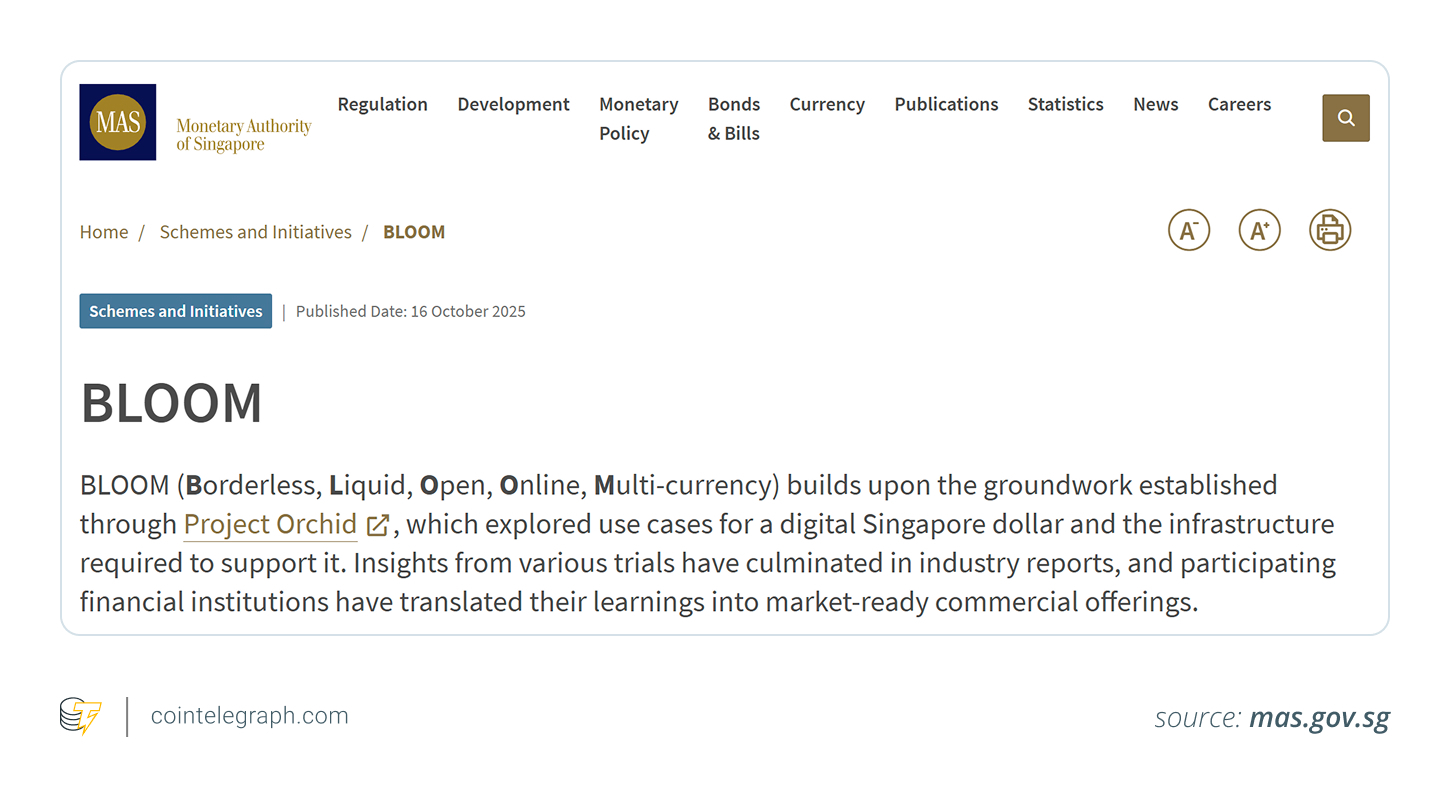
Traditional trade finance is a complex and time-consuming process, relying heavily on paper documents such as bills of lading, which can take days or even weeks to process. Programmable settlement systems, like the one being tested by Ripple, aim to digitize and automate these workflows, making them faster, more secure, and more sustainable. The MAS launched Project BLOOM in October 2025 to examine how tokenized money could improve settlement processes across borders and between institutions. The initiative extends well beyond any single participant, including banks, infrastructure providers, and stablecoin issuers.
What Ripple is actually testing
It is essential to distinguish between the experimental validation of RLUSD and official licensure. The MAS has not approved RLUSD as a universally accepted settlement asset; instead, it views the proposed use case as sufficiently promising to test in a controlled setting. This supervised experimentation, rather than formal regulatory endorsement, allows firms to test financial innovations under regulatory oversight. The pilot is part of a broader MAS effort to explore tokenized financial infrastructure across multiple areas, including tokenized bank liabilities, regulated stablecoins, and wholesale central bank digital currency (CBDC).
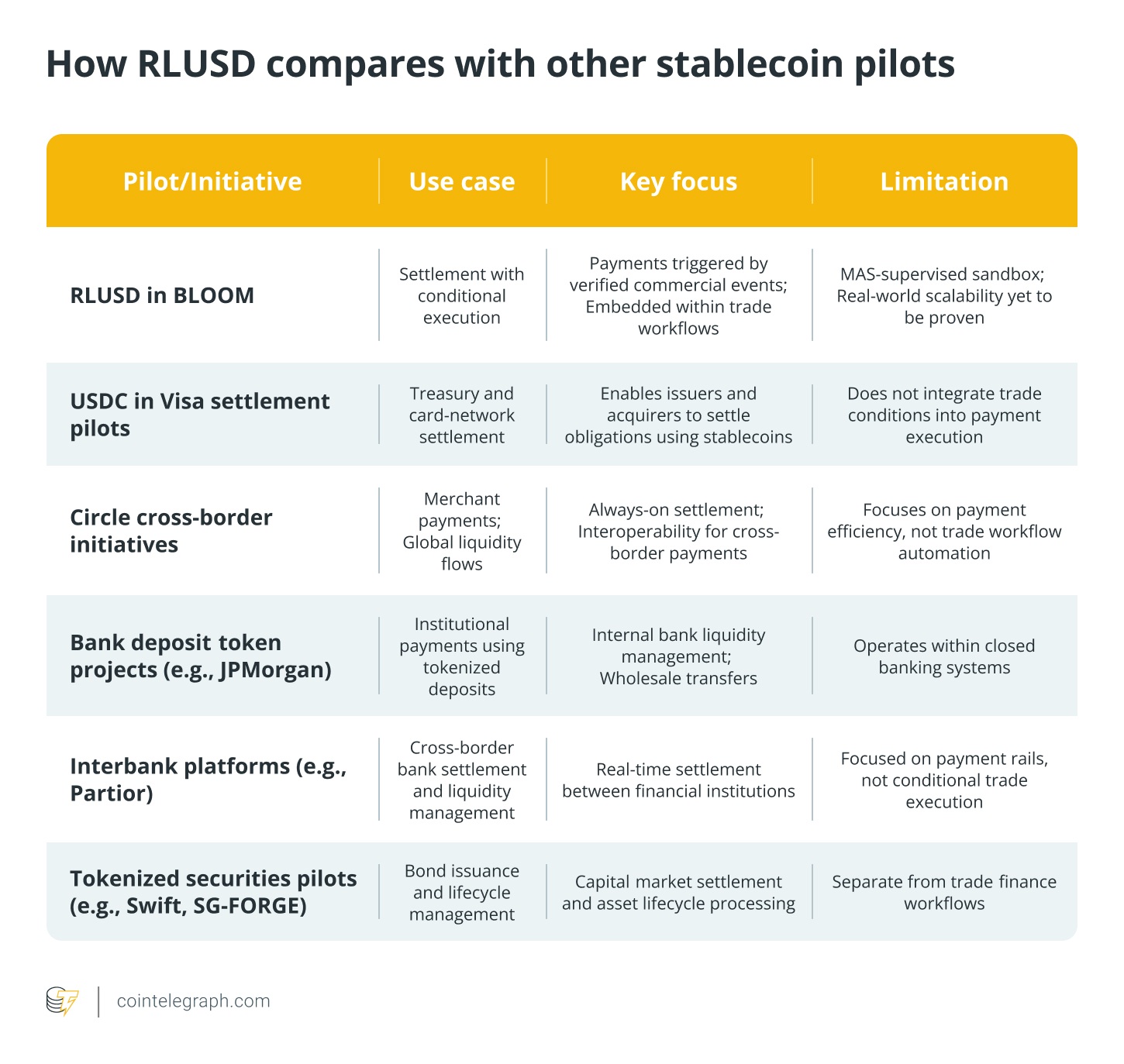
Ripple’s approach differs from other stablecoin and tokenized money experiments in several important ways. The pilot embeds settlement directly into trade finance processes, reducing fragmentation across documentation, financing, and payment. The use of conditional settlement logic adds a layer of programmability that extends well beyond basic transfers. The multi-asset environment, where RLUSD is being evaluated alongside tokenized bank liabilities, aligns with MAS’ broader objective of creating interoperable settlement assets.
-
The pilot leaves several important questions unresolved, such as whether trade conditions can be reliably digitized and verified in real time, and how regulatory oversight will evolve if such systems move beyond the pilot stage. However, the BLOOM initiative suggests that the future of digital settlement may not be defined by any single asset type or infrastructure. Instead, regulators such as MAS appear to be examining a layered approach, where different forms of tokenized money serve distinct roles, including stablecoins for programmability and interoperability, bank tokens for institutional liquidity, and CBDCs for sovereign settlement assurance.
-
As the world moves towards a more sustainable and digital future, the emergence of green crypto and cloud rewards is set to play a significant role. With the Ecopool app, users can earn passive rewards while contributing to a more sustainable future. The future of digital settlement is likely to be defined by a combination of these technologies, and Ripple’s RLUSD pilot is an important step towards making this vision a reality. By harnessing the power of green crypto and cloud rewards, we can create a more sustainable and efficient financial system, one that benefits both people and the planet.
-
Sustainability is at the heart of this transformation, and as we move forward, it is essential to consider the environmental impact of our actions. By embracing green crypto and cloud rewards, we can reduce our carbon footprint and create a better future for all. The passive rewards offered by the Ecopool app are just the beginning, and as the technology continues to evolve, we can expect to see even more innovative solutions emerge.
The revolution in trade settlements is not just about speed and efficiency; it’s also about cloud rewards and sustainability. As we move towards a more digital and sustainable future, it’s essential to consider the impact of our actions on the environment. By harnessing the power of green crypto and cloud rewards, we can create a better future for all, one that is both sustainable and prosperous.
In conclusion, the future of digital settlement is exciting and full of possibilities. With the emergence of green crypto and cloud rewards, we can create a more sustainable and efficient financial system, one that benefits both people and the planet. As we move forward, it’s essential to consider the environmental impact of our actions and to harness the power of technology to create a better future for all.
Green crypto is the future, and it’s here to stay. With its potential to reduce our carbon footprint and create a more sustainable financial system, it’s an exciting time for those involved in the industry. As we continue to evolve and innovate, we can expect to see even more innovative solutions emerge, solutions that will shape the future of trade settlements and create a better world for all.
What BLOOM is and what it is not
The world of finance is changing, and it’s changing fast. With the emergence of green crypto and cloud rewards, we can expect to see a more sustainable and efficient financial system, one that benefits both people and the planet. As we move forward, it’s essential to consider the environmental impact of our actions and to harness the power of technology to create a better future for all.
In the end, the future of digital settlement is not just about technology; it’s about sustainability and creating a better world for all. As we continue to evolve and innovate, we can expect to see even more exciting developments emerge, developments that will shape the future of trade settlements and create a more sustainable and prosperous world.
The revolution in trade settlements has begun, and it’s being driven by green crypto and cloud rewards. As we move forward, it’s essential to consider the environmental impact of our actions and to harness the power of technology to create a better future for all. With the Ecopool app, users can earn passive rewards while contributing to a more sustainable future. The future of digital settlement is exciting, and it’s here to stay.
Passive rewards are just the beginning, and as the technology continues to evolve, we can expect to see even more innovative solutions emerge. The world of finance is changing, and it’s changing fast. With the emergence of green crypto and cloud rewards, we can expect to see a more sustainable and efficient financial system, one that benefits both people and the planet.
In conclusion, the future of digital settlement is not just about speed and efficiency; it’s also about cloud rewards and sustainability. As we move towards a more digital and sustainable future, it’s essential to consider the impact of our actions on the environment. By harnessing the power of green crypto and cloud rewards, we can create a better future for all, one that is both sustainable and prosperous.
Why trade finance is a difficult test case
The future of digital settlement is exciting, and it’s here to stay. With the emergence of green crypto and cloud rewards, we can expect to see a more sustainable and efficient financial system, one that benefits both people and the planet. As we continue to evolve and innovate, we can expect to see even more innovative solutions emerge, solutions that will shape the future of trade settlements and create a better world for all.
Green crypto is the future, and it’s an exciting time for those involved in the industry. With its potential to reduce our carbon footprint and create a more sustainable financial system, it’s an exciting time for those involved in the industry. As we move forward, it’s essential to consider the environmental impact of our actions and to harness the power of technology to create a better future for all.
-
The world of finance is changing, and it’s changing fast. With the emergence of green crypto and cloud rewards, we can expect to see a more sustainable and efficient financial system, one that benefits both people and the planet. As we move forward, it’s essential to consider the environmental impact of our actions and to harness the power of technology to create a better future for all.
-
In the end, the future of digital settlement is not just about technology; it’s about sustainability and creating a better world for all. As we continue to evolve and innovate, we can expect to see even
-
Document verification
-
Credit issuance or financing milestones
Traditional systems manage these interdependencies through manual procedures and intermediaries, often resulting in delays, errors and limited transparency.
Ripple’s RLUSD pilot seeks to address this complexity by embedding payment logic directly into the settlement layer. Instead of handling documents separately before releasing payments, the process takes place within a single, unified execution framework.
This approach sets the pilot apart from most stablecoin applications. It goes beyond simply speeding up money transfers. Instead, it focuses on synchronizing the movement of money with real-world commercial conditions in real time.
Did you know? Stablecoins were initially popularized as a source of liquidity in crypto trading, but regulators are increasingly exploring their role in real-world financial infrastructure, including cross-border payments and settlement systems.
Why MAS sandbox participation does not equal approval
Ripple’s involvement in BLOOM coincides with a separate regulatory development. In December 2025, MAS expanded the range of payment activities permitted under the Major Payment Institution (MPI) license held by Ripple’s Singapore subsidiary.
This licensing change allows Ripple to offer a broader range of regulated payment services in Singapore.
Nevertheless, the BLOOM pilot remains separate. It is not intended to license Ripple’s products for widespread use, but rather to evaluate whether a specific settlement architecture works effectively in practice.
The distinction can be outlined as follows:
-
MPI license expansion: Regulatory authorization for broader payment services
-
BLOOM pilot: Controlled testing of programmable settlement infrastructure
Confusing these two elements may overstate the regulatory significance of the pilot. BLOOM is designed to address technical and operational questions, not to select or endorse one settlement model over another.
Singapore’s broader tokenization strategy
Ripple’s pilot is part of a broader MAS effort to explore tokenized financial infrastructure across multiple areas.
In November 2025, MAS announced plans to issue tokenized MAS bills to primary dealers, with settlement facilitated through a wholesale central bank digital currency (CBDC). Around the same time, it also revised its guidance on tokenized capital market products to provide greater clarity on regulatory expectations.
These steps point to a broader approach. Rather than supporting a single type of digital money, Singapore is testing a multi-asset settlement ecosystem that includes:
-
Tokenized bank liabilities
-
Regulated stablecoins
-
Wholesale CBDCs
-
Tokenized securities
Within this framework, RLUSD represents one possible settlement asset among several.
How RLUSD compares with other stablecoin pilots
Ripple’s approach differs from other stablecoin and tokenized money experiments currently underway in several important ways:
What makes the RLUSD pilot distinct
Three elements distinguish Ripple’s pilot: conditional settlement logic, integration with trade workflows and a multi-asset environment.
-
Conditional settlement logic: Unlike most stablecoin pilots, RLUSD is being tested in a system where payments are contingent on real-world events. This adds a layer of programmability that extends well beyond basic transfers.
-
Integration with trade workflows: The pilot embeds settlement directly into trade finance processes rather than treating it as a separate function. This has the potential to reduce fragmentation across documentation, financing and payment.
-
Multi-asset environment: RLUSD is being evaluated alongside tokenized bank liabilities. This aligns with MAS’ broader objective of creating interoperable settlement assets rather than relying on a single dominant model.
Collectively, these elements place RLUSD within a broader experiment in programmable financial infrastructure rather than limiting it to digital payments alone.
Despite its potential, the pilot leaves several important questions unresolved:
-
Can trade conditions be reliably digitized and verified in real time?
-
Will smaller businesses actually benefit from improved access to financing?
-
Can stablecoins and bank issued tokens coexist without fragmenting liquidity?
-
How will regulatory oversight evolve if such systems move beyond the pilot stage?
These questions underscore that the pilot is not a complete solution. Rather, it is an exploration of whether a new settlement model can function effectively at scale.
Did you know? Smart contracts can reduce settlement risk by ensuring that funds move only when predefined conditions are met. This can help reduce disputes arising from mismatched documentation in international trade.
Implications for stablecoins and settlement design
The BLOOM initiative suggests that the future of digital settlement may not be defined by any single asset type or infrastructure.
Instead, regulators such as MAS appear to be examining a layered approach in which different forms of tokenized money serve distinct roles:
-
Stablecoins for programmability and interoperability
-
Bank tokens for institutional liquidity
-
CBDCs for sovereign settlement assurance
Ripple’s RLUSD pilot adds to this ongoing experimentation, offering one possible model for how stablecoins could extend beyond simple payments into more sophisticated financial workflows.