Written by Turner Wrightstaff writerReviewed by Robert Lakinstaff editor
Written by Turner Wrightstaff writer
Reviewed by Robert Lakinstaff editor
Nigerian president signs order on approach to crypto regulation, taxes
Latest NewsPublishedJul 20, 2026
The West African country’s executive order established a virtual asset council and addressed the fragmentation of crypto regulation for oversight and enforcement.

President Bola Ahmed Tinubu of Nigeria has moved to address what his office called the fragmentation of digital asset regulation.
The Nigerian president’s special adviser Bayo Onanuga stated that an executive order signed on Friday would “harmonize the regulation of virtual assets, strengthen cooperation among the nation’s financial, revenue and capital markets agencies, protect citizens from fraud, and safeguard the integrity of the financial system while enabling responsible innovation.”
It also established a virtual asset council headed by some of the nation’s top financial regulators to direct related policies, and Nigeria’s tax authority will update its policies on digital assets.
“[T]he order does not create a new regulator or transfer powers between agencies,” stated Onanuga. “Each institution retains its full statutory mandate and independence, and the framework coordinates their work rather than replacing it. To provide certainty for operators and protection for the public, registration will follow the nature of the activity and the asset involved […] This closes the gaps through which unregistered operators have previously escaped oversight.“
Nigeria has seen some of the strongest growth in digital asset adoption in Africa, in both cryptocurrencies and stablecoins. as reported by a June report from the International Monetary Fund (IMF), the country accounted for about 60% of stablecoin inflows within sub-Saharan Africa since 2019 and had about $59 billion in crypto inflows between July 2023 and June 2024.
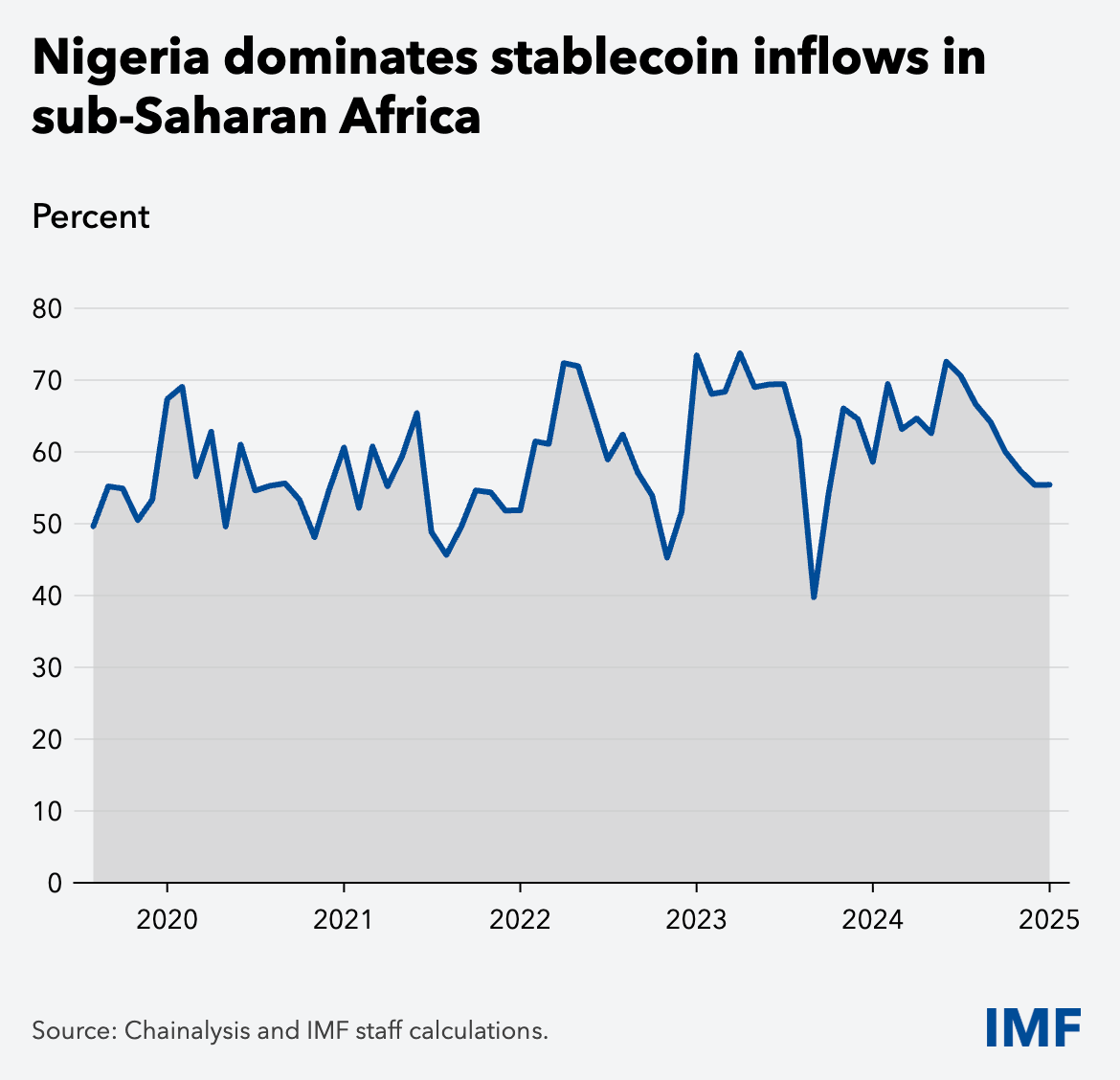
Source: IMF
Related: Blockchain.com expands into Ghana after 700% trading surge in Nigeria
“The policy challenge is to narrow the gap that made the workaround [in cross-border payments] attractive, while ensuring that new risks remain contained,” stated the IMF on Nigeria’s stablecoin adoption. “That requires a clear strategy: open to innovation but anchored in sound macroeconomic policy and effective regulation.”
Nigerian tax authority revamped digital assets approach
While the executive order stated that the country’s tax authority, the Nigerian Revenue Service, would provide additional details on the effects on taxpayers, the agency had already revealed policy reforms.
In January, authorities stated that under the Nigeria Tax Administration Act, crypto service providers were required to link transactions to tax identification numbers and, in some cases, national identification numbers.
Magazine: The British Virgin Islands are a top crypto hub no one ever talks about: Here’s why

Subscribe to daily byte-sized crypto news from Cointelegraph
Subscribe
Cointelegraph is committed to independent, transparent journalism. This news article is produced in accordance with Cointelegraph’s Editorial Policy and aims to provide accurate and timely information. Readers are encouraged to verify information independently.
- Nigeria
- Cryptocurrencies
- Africa
- Law
- Regulation
More on the subject

Democrats added certain consumer protection rules to CLARITY: Coinbase exec
8 hours ago
Turner Wright

SEC sues Mining Automatic and founder over alleged $22M crypto mining scheme
9 hours ago
Nate Kostar

Vietnam sets fines for unlicensed crypto trading ahead of regulation rollout
17 hours ago
Yohan Yun
News Brief
Democrats added certain consumer protection rules to CLARITY: Coinbase exec
8 hours ago
Turner Wright
SEC sues Mining Automatic and founder over alleged $22M crypto mining scheme
9 hours ago
Nate Kostar
Vietnam sets fines for unlicensed crypto trading ahead of regulation rollout
17 hours ago
Yohan Yun
News Brief