
Written by Brian Quarmby, Staff Writer. Reviewed by Felix Ng, Staff Editor.
Written by Brian Quarmby, Staff Writer.
Reviewed by Felix Ng, Staff Editor.
Polygon rolls out private stablecoin payments targeting institutions
Latest NewsPublishedMay 5, 2026
The new wallet feature hides senders, receivers and amounts onchain while maintaining compliance through know your transaction screening and auditable files.

Ethereum scaling solution Polygon has introduced private stablecoin payments in an effort to attract more businesses and institutions to the chain.
In a statement on Sunday, Polygon introduced its new wallet feature that enables users to privately route transactions through a shielded pool, with verification handled by zero-knowledge proofs. The move is part of an integration with privacy protocol Hinkal.
“For onchain payments to go mainstream, businesses need privacy. Not ‘hide from regulators’ privacy. Operational privacy,” pointed out Polygon community lead Smokey on X.
Privacy was one of the biggest crypto themes in 2025, with many crypto assets tied to privacy projects surging last year despite a broader market downturn. Polygon highlighted the importance of privacy, arguing that many institutions are unlikely to move notable volume onchain without it.
“Confidentiality has been the single biggest gap between onchain rails and what institutional finance actually needs to move serious stablecoin volume,” Polygon stated.
“Banks, treasuries and payments teams already live with confidentiality on traditional rails. They won’t move operational flows onto a ledger that broadcasts every counterparty and every amount to every observer on the network.”
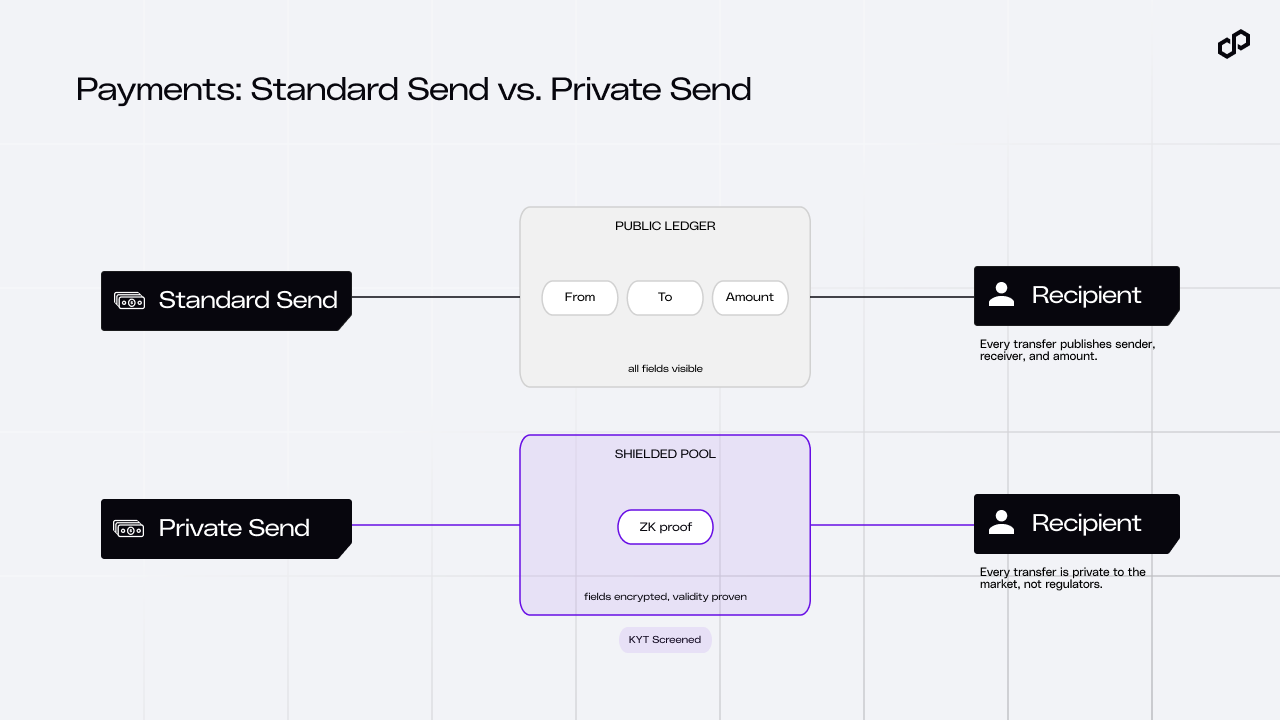
Payment process for private transactions vs normal transactions. Source: Polygon
Polygon’s new feature is that it enables users to hide transactions from the public while maintaining compliance and auditability. Polygon stated that “privacy means opacity to the market, not opacity to regulators.”
This happens in two key ways. First, every private transaction on Polygon “passes through KYT (Know Your Transaction) screening before execution.” Meanwhile, Hinkal’s documentation indicates that users can generate audit files to hand over to tax officials or regulators.
The move from Polygon comes just weeks after layer-1 blockchain Aptos made its own privacy play by launching the Confidential APT coin on April 24.
The coin is pegged to the value of the Aptos (APT) token and uses zero-knowledge proofs to conceal and verify transfer information.
Related: DeFi can freeze stolen funds, but not everyone agrees it should
The total market capitalization of stablecoins on Polygon hit an all-time high of $3.6 billion on April 10, as reported by data from DefiLlama, making it the eighth-largest stablecoin chain.
US passage of the stablecoin-friendly GENIUS Act in July last year sparked an uptick in interest and trading volume for the asset class. On Sunday, Western Union became the latest traditional finance firm to launch a stablecoin through its USD-pegged USDPT on Solana.
Magazine: AI-driven hacks could kill DeFi — unless projects act now
Cointelegraph is committed to independent, transparent journalism. This news article is produced in accordance with Cointelegraph’s Editorial Policy and aims to provide accurate and timely information. Readers are encouraged to verify information independently.
More on the subject

Coinbase launches crypto service for Australian retirement funds
9 hours ago
Ezra Reguerra

Space and Time rolls out virtual vaults for institutional onchain lending
10 hours ago
Robert Lakin

Dutch users still access prediction markets despite Polymarket ban
11 hours ago
Amin Haqshanas
Coinbase launches crypto service for Australian retirement funds
9 hours ago
Ezra Reguerra
Space and Time rolls out virtual vaults for institutional onchain lending
10 hours ago
Robert Lakin
Dutch users still access prediction markets despite Polymarket ban
11 hours ago
Amin Haqshanas