Are you curious why a price move can wipe out a trader’s position in minutes? This article explains leveraged trading, how liquidations happen, and what you should consider before using leverage to earn crypto.
What leveraged trading actually is
Leveraged trading lets you open a position that is larger than the amount of capital you actually put down, called collateral. The exchange or platform supplies the extra funds, called the borrowed amount, and you agree to repay it with interest. Your own money is the margin. For example, with 10× leverage you can control $10,000 worth of Bitcoin while only posting $1,000 as margin.
Leverage amplifies both potential profit and potential loss. If the market moves in your favor, your gains are multiplied by the leverage factor. If it moves against you, losses are multiplied as well. When the value of your collateral falls below a certain threshold, the exchange will automatically close your position to protect itself. This forced closure is called a liquidation.
Exchanges set a maintenance margin level, usually a few percent of the total position size. As long as your equity (collateral plus unrealized profit/loss) stays above this level, the trade remains open. Once equity drops below the maintenance margin, the platform triggers a liquidation to prevent the trader’s debt from exceeding the collateral.
A real‑world illustration
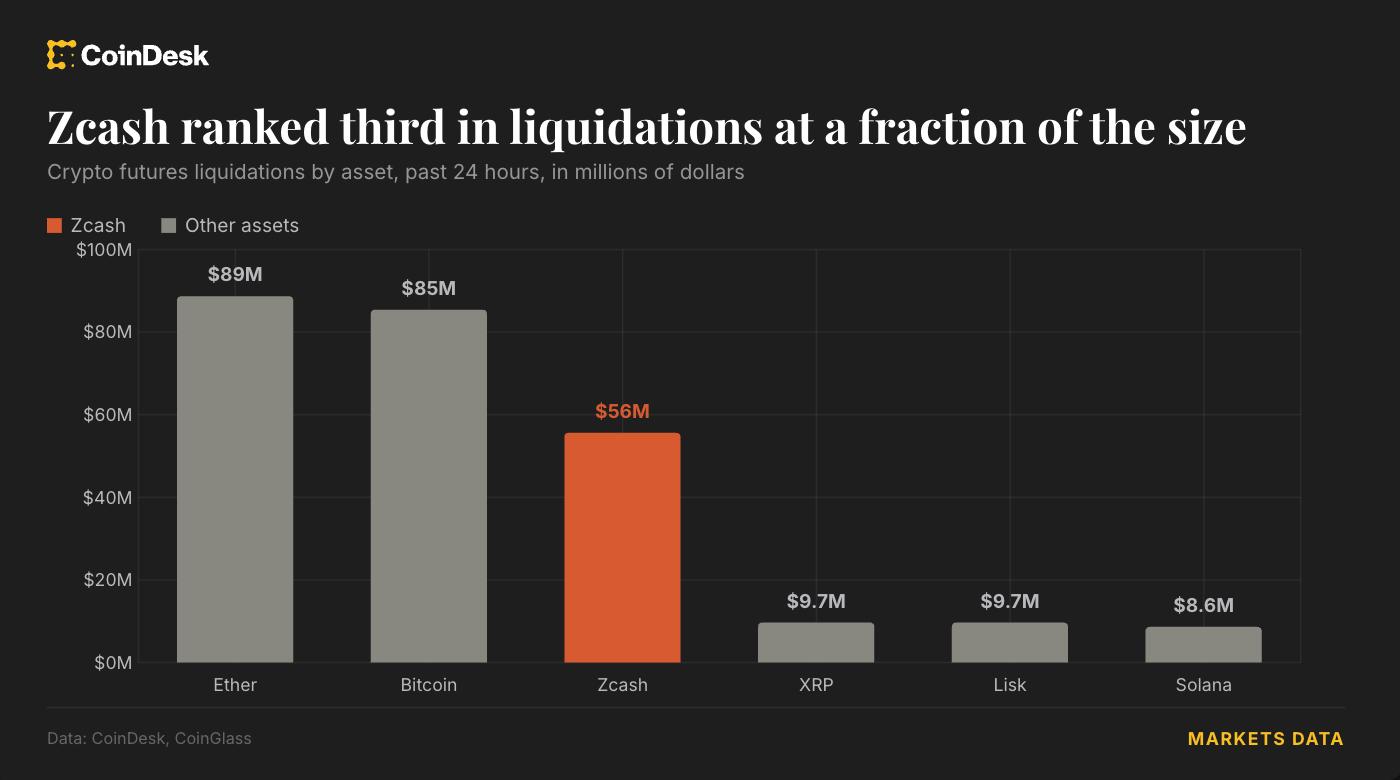
On a Thursday morning in Asian markets, Zcash surged more than 17% to about $1,358, while a wave of liquidations swept the crypto market. According to data from CoinGlass, 86,816 traders were liquidated in a 24‑hour period, costing a total of $345 million. Short positions—bets that prices would fall—accounted for $208 million of the losses, and long positions for $137 million. Zcash itself contributed $56 million of the liquidated value despite a market cap of roughly $23 billion.
This event shows how quickly leveraged positions can be forced closed when price moves are sharp, especially when many traders are on the same side of the market. The Federal Reserve’s interest‑rate hike that day added volatility, but the core mechanism was the same: traders’ collateral could no longer cover their leveraged exposure, so exchanges liquidated them.
What it means for you
If you are looking to earn crypto by trading, leverage can seem attractive because it promises larger returns on a modest investment. However, the same mechanism that can boost profits can also erase your capital in a single move. The risk is especially high in markets that experience sudden news‑driven spikes, like the Fed rate decision that preceded the Zcash rally.
Before you add leverage to your strategy, ask yourself whether you can tolerate losing the entire amount you put up as margin. Remember that liquidation fees, funding rates, and interest on borrowed funds further reduce any potential profit.
What to check before using leverage
- Maintenance margin level: Know the exact percentage at which the platform will liquidate your position. Lower maintenance margins give you a larger safety buffer.
- Leverage ratio: Use the smallest leverage that still meets your strategy goals. Many experienced traders stay at 2× or 3× to limit risk.
- Liquidation price calculator: Most exchanges provide a tool that shows the price at which your position will be liquidated based on current collateral and leverage.
- Fee structure: Understand liquidation fees, funding rates, and borrowing costs, as they can eat into returns even if the trade does not get liquidated.
- Risk management tools: Set stop‑loss orders or use partial liquidation features if the platform offers them.
- Platform reputation: Choose exchanges with transparent margin policies and a history of reliable liquidation handling.
FAQ
What is the difference between a short and a long position?
A long position profits when the price of the asset rises; a short position profits when the price falls. Both can be leveraged, and both are subject to liquidation if the market moves against them.
Can I avoid liquidation altogether?
Using no leverage eliminates liquidation risk. If you do use leverage, keeping a large cushion of collateral above the maintenance margin and employing stop‑loss orders can reduce the chance of forced closure.
Do liquidation fees apply to every forced close?
Yes. Exchanges typically charge a fee on top of the loss incurred from the price move. The fee varies by platform and can be a fixed amount or a percentage of the position size.
Is leveraged trading suitable for passive income?
Leveraged trading is an active strategy that requires constant monitoring and risk management. It is generally not considered a reliable source of passive income, especially for beginners.
This article references reporting from coindesk.com.