Ever wonder why a token’s price can rise even while money leaves its exchange‑traded fund (ETF)? This article explains how crypto ETFs work, why inflows and outflows happen, and what those flows mean for anyone trying to earn from digital assets.
What a Crypto ETF Is and How It Operates
An exchange‑traded fund, or ETF, is an investment vehicle that holds a basket of assets and trades on a traditional stock exchange. A crypto ETF does the same, but the underlying assets are cryptocurrencies such as Bitcoin, Ethereum, or Zcash. When you buy shares of a crypto ETF, you are not buying the coins directly; instead, you own a proportional claim on the fund’s holdings.
ETF providers acquire the actual crypto on the open market, store it (often in custodial wallets), and issue shares that reflect the fund’s net asset value (NAV). The NAV is calculated by adding up the market value of all holdings and dividing by the number of shares outstanding. Because the shares trade on an exchange, their price can deviate slightly from the NAV, creating a small premium or discount.
Two key processes drive an ETF’s size:
- Inflows: Investors buy shares, and the fund manager purchases more crypto to keep the NAV in line with the share price.
- Outflows: Investors sell shares, and the manager sells crypto to redeem the cash, reducing the fund’s holdings.
These flows are recorded daily and reported by data providers. They give a snapshot of how much capital is moving into or out of a particular crypto exposure.
Why Inflows and Outflows Matter
Large inflows can signal growing confidence in a token, potentially supporting its price as demand for the underlying asset rises. Conversely, sizable outflows may indicate waning interest, which can put downward pressure on the token’s market price if the selling pressure is significant.
However, the relationship is not always one‑to‑one. A token’s price can rise even as its ETF experiences outflows if other market participants—such as retail traders, institutional buyers, or miners—are buying on spot markets. Similarly, inflows might not lift a price if the broader market sentiment is negative.
Understanding ETF flows helps you gauge the “institutional mood” around a cryptocurrency, but it should be combined with other indicators like on‑chain activity, trading volume, and macro‑economic factors.
Real‑World Illustration
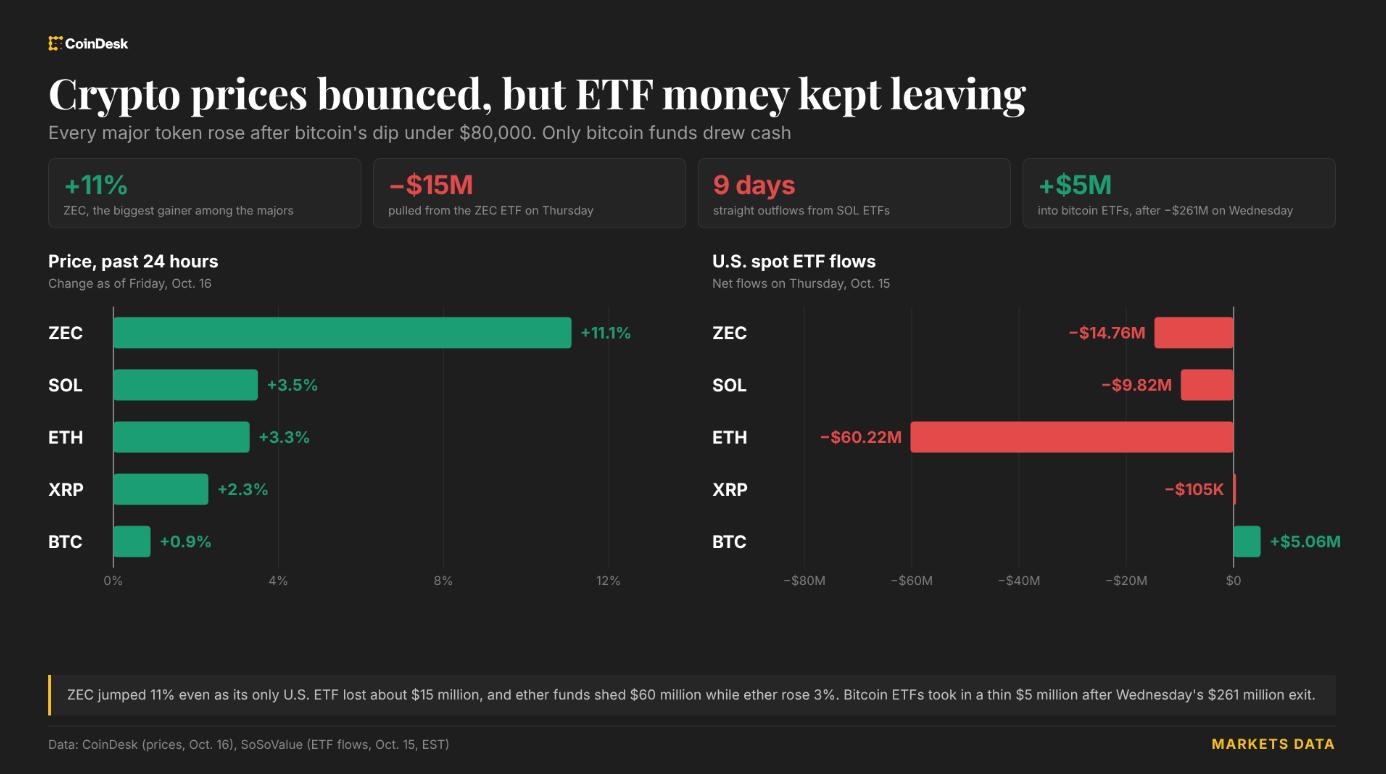
In March 2026, Bitcoin briefly slipped below $80,000 before climbing back above $82,000. At the same time, Zcash (ZEC) surged 11% to roughly $1,230, even though its sole U.S. spot ETF recorded a $15 million outflow that day—the fund’s fifth outflow of the month. Other crypto ETFs, such as those for Ether and Solana, also saw notable withdrawals, while Bitcoin ETFs logged a modest $5 million net inflow after a prior $261 million exit.
This snapshot shows that a token’s price movement can diverge from its ETF’s cash flows. ZEC’s price jump occurred despite investors pulling money from its ETF, suggesting that spot‑market buying outweighed the impact of the outflow.
What It Means for You
If you are looking to earn passive income through crypto exposure, ETF flows give you a quick sense of where larger investors are positioning themselves. A steady stream of inflows might make an ETF‑based strategy feel safer, while persistent outflows could warn you to investigate why confidence is slipping.
At the same time, don’t rely solely on ETF data. Spot market dynamics, mining rewards, staking yields, and broader economic news all affect price and earning potential. Diversifying across different earning methods—such as staking, cloud mining, or holding spot positions—can help smooth out the impact of any single factor.
How to Evaluate an ETF Before Using It
- Check the fund’s size and liquidity. Larger, more liquid ETFs tend to have tighter spreads between share price and NAV, reducing hidden costs.
- Look at recent inflow/outflow trends. Consistent inflows may indicate growing demand; sudden large outflows merit a deeper look.
- Review the custody solution. Reputable custodians lower the risk of loss or theft of the underlying crypto.
- Understand fee structure. Management fees and transaction costs eat into earnings, especially for long‑term holders.
- Compare the ETF’s performance to the spot price. A persistent premium or discount can affect your effective return.
FAQ
Why can a token’s price rise while its ETF experiences outflows?
ETF outflows reflect investors selling shares, not necessarily all spot‑market holders. If other buyers are active on exchanges, their demand can push the price up despite the ETF’s withdrawals.
Do ETF inflows guarantee higher prices?
No. Inflows show that money is entering the fund, but price movements also depend on overall market sentiment, supply dynamics, and external news. Inflows are just one piece of the puzzle.
Are crypto ETFs safer than buying the coins directly?
ETFs add a layer of professional custody and regulatory oversight, which can reduce certain risks. However, they also introduce management fees and the risk that the fund’s share price may diverge from the underlying asset’s price.
Can I earn passive income from a crypto ETF?
Most crypto ETFs do not distribute staking or mining rewards directly to shareholders; they aim to track price performance. To earn passive income, you may need to look at staking platforms, cloud mining services, or dividend‑paying tokens.
This article references reporting from coindesk.com.