
Wondering why some Ethereum transactions suddenly become expensive or why miners talk about “gas limits” in each block? This article explains what gas is, how the block gas limit works, and what changes to that limit mean for everyday users and miners.
What is gas and how does the block gas limit work?
In Ethereum, gas is the unit that measures the computational effort required to execute operations on the blockchain. Every action—sending ETH, interacting with a smart contract, or deploying new code—consumes a certain amount of gas. Users pay for this gas in ether (ETH), the network’s native cryptocurrency, by specifying a gas price (the amount of ETH they are willing to pay per unit of gas). The total fee for a transaction is the gas used multiplied by the gas price.
The block gas limit is the maximum amount of gas that all transactions in a single block can collectively consume. Miners (or validators, after the proof‑of‑stake transition) pack transactions into a block until the sum of their gas usage reaches this limit. The limit is not a hard cap on the number of transactions; it caps the total computational work, ensuring that a block can be processed by the network within a reasonable time.
When the network upgrades, the protocol can adjust the block gas limit. Raising the limit allows more or more complex transactions per block, potentially increasing the number of fees a miner can collect. Lowering it can improve network stability but reduces the throughput of transactions.
Real‑world example: the Glamsterdam test
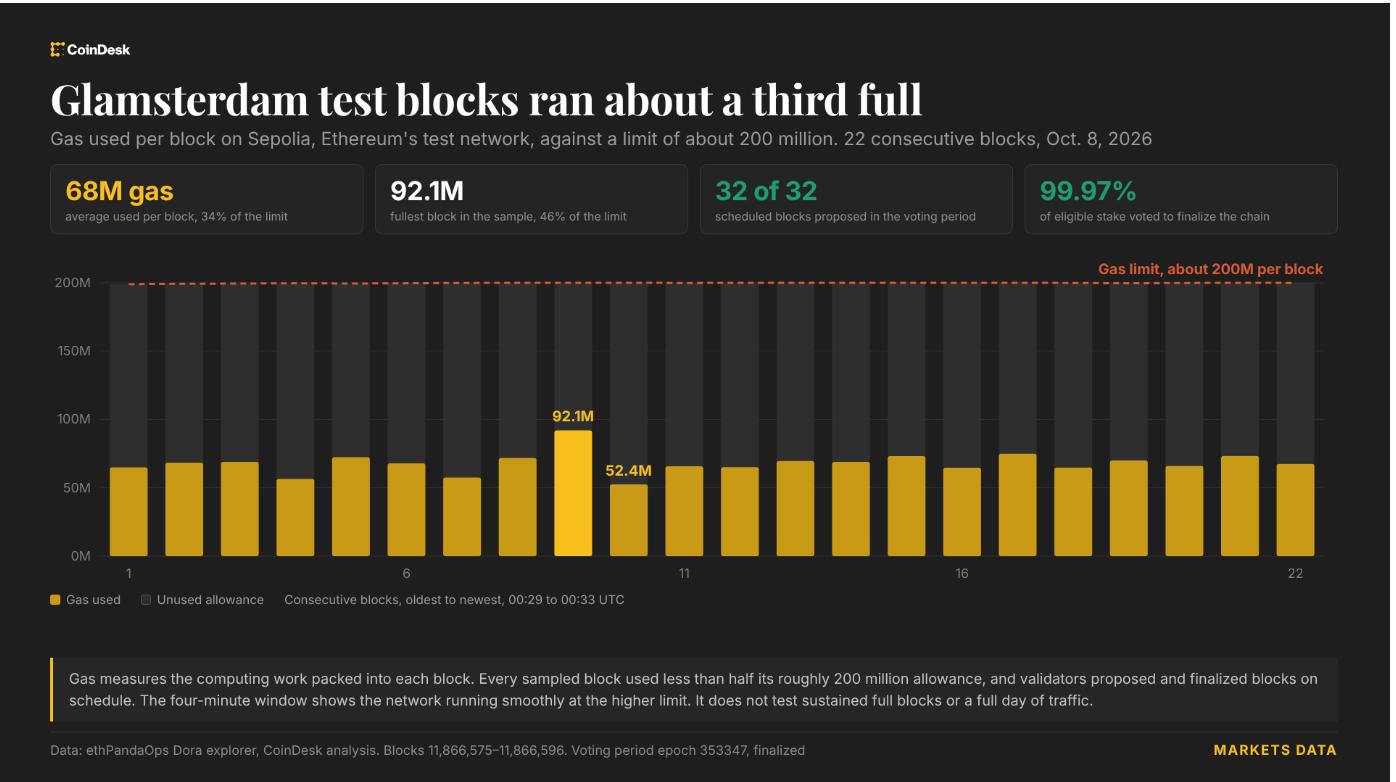
In March 2026, Ethereum’s “Glamsterdam” testnet demonstrated a block gas usage of nearly 200 million gas per block after a recent protocol upgrade. This test showed that the upgraded software could handle blocks far larger than the typical main‑net limit of about 30 million gas at the time. The experiment was designed to explore the upper bounds of block size, assess how validators would handle the increased load, and gauge the impact on transaction fees.
What this means for you
For everyday users, a higher block gas limit can translate into lower transaction fees during periods of high demand, because the network can accommodate more transactions in each block. However, if the limit is raised without corresponding improvements in network efficiency, it may lead to longer block propagation times, which can cause temporary instability.
For miners or validators seeking passive income through block rewards and transaction fees, a larger gas limit offers the potential to earn more fees per block—provided they can include high‑gas transactions. Yet, they also face higher hardware or infrastructure demands to process larger blocks quickly, which can affect profitability.
How to evaluate the impact of gas‑limit changes
- Check the current block gas limit: Block explorers display the limit for each block. Compare it to historical values to see trends.
- Monitor average gas usage: If blocks consistently approach the limit, fees are likely to rise; if usage is well below the limit, fees may stay low.
- Assess validator performance: Larger blocks require more bandwidth and faster processing. Validators should ensure their hardware can keep up to avoid penalties.
- Watch for protocol upgrades: Major upgrades (e.g., Shanghai, Dencun) often adjust the gas limit. Reading the official Ethereum Improvement Proposals (EIPs) gives insight into the intended changes.
FAQ
Why do transaction fees sometimes spike even if the gas limit hasn’t changed?
Fees rise when the demand for block space exceeds supply. If many users submit high‑gas transactions, miners prioritize those offering higher gas prices, pushing the average fee up.
Can I set my own gas limit for a transaction?
Yes, you can specify a gas limit for each transaction, which is the maximum gas you’re willing to allow the operation to consume. If the transaction needs more gas than you set, it will fail and you’ll still lose the fee for the gas used up to that point.
Does a higher block gas limit make Ethereum faster?
Not directly. It allows more work per block, but the block time (the interval between blocks) stays roughly the same. Faster processing depends on network upgrades that improve scalability, such as rollups or sharding.
Will a larger gas limit affect the security of the network?
Potentially. Bigger blocks take longer to propagate, which can increase the risk of temporary forks. Protocol designers balance the limit to maintain security while improving throughput.
This article references reporting from coindesk.com.





