Are you curious about why certain crypto tokens suddenly surge while others stay flat, and how you can tap into that growth? This article explains what layer‑2 solutions and decentralized finance (DeFi) tokens are, how they generate value, and what you should consider before seeking earnings from them.
What layer‑2 solutions and DeFi tokens actually are
A layer‑2 solution is a set of protocols built on top of an existing blockchain (the “layer‑1”) to improve scalability, speed, and cost. Think of it as a side road that relieves traffic on a busy highway. Popular layer‑2 networks like Arbitrum and StarkNet process transactions off‑chain and then settle the final results on the main chain, reducing fees and increasing throughput.
Decentralized finance (DeFi) tokens represent assets that power financial services without traditional intermediaries. These tokens can be used for lending, borrowing, swapping, or providing liquidity on decentralized exchanges (DEXs). Uniswap’s UNI token, for example, gives holders voting rights in the protocol and a share of fees generated by the DEX.
Both layer‑2 and DeFi tokens are often tied to the health of the underlying blockchain. When a layer‑2 network gains users, its native token may appreciate because it is needed to pay for transaction fees or to participate in governance. Similarly, a DeFi token’s value can rise when more capital flows into the protocol, increasing trading volume and fee revenue.
A real‑world illustration
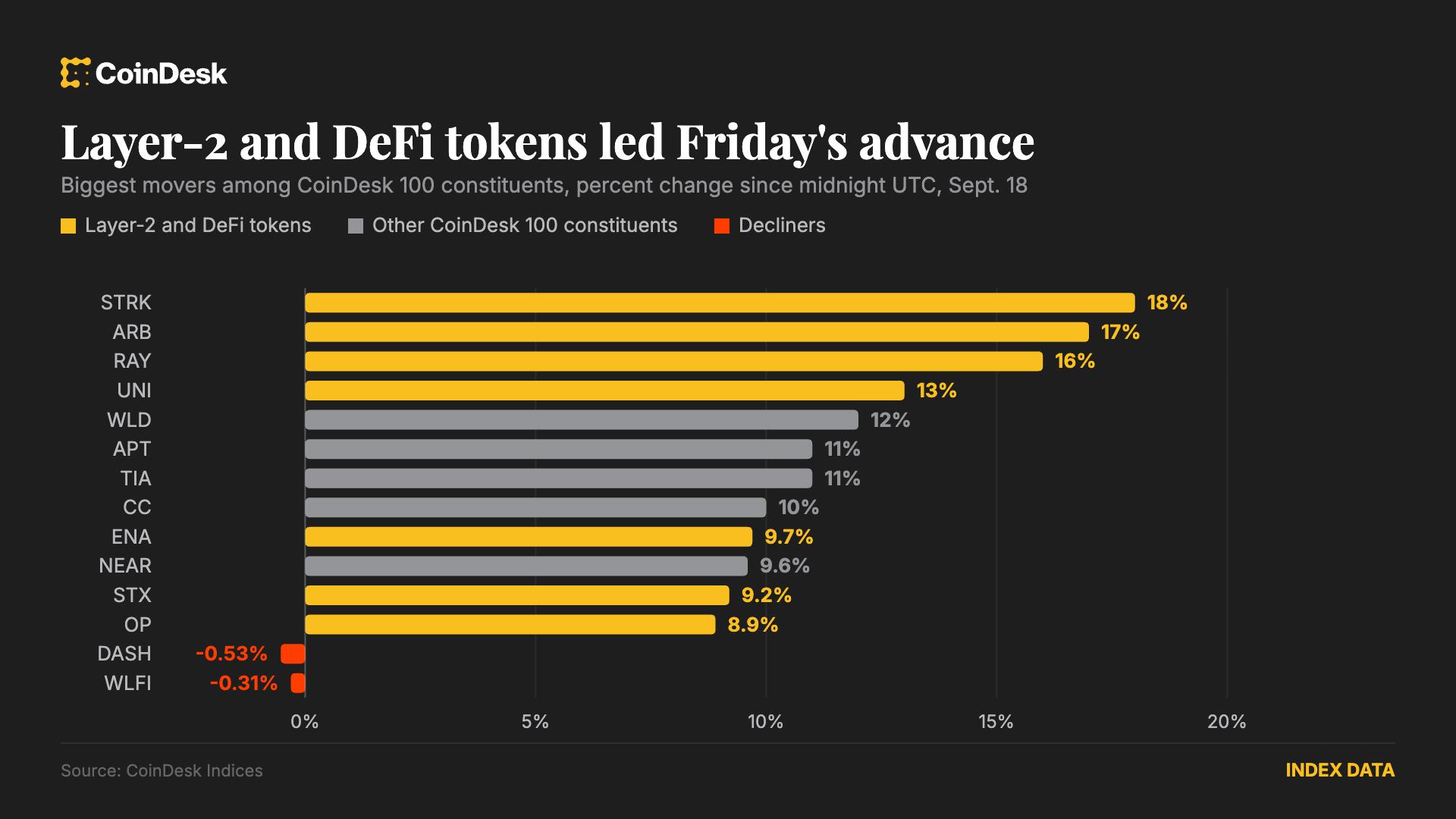
On a Friday in early September 2026, the crypto market showed a clear shift toward risk‑on assets. Layer‑2 tokens such as StarkNet (STRK) jumped 18% and Arbitrum (ARB) rose 17%, while the DeFi token Uniswap (UNI) surged 13% during the European morning. The broader DeFi Select Index gained 8.3%. Analysts linked this rally to a softer macro backdrop—U.S. Treasury yields falling below 5% and oil prices easing—making investors more comfortable taking on higher‑risk crypto positions.
What this means for you as an online earner
If you’re looking to earn passive income or capital gains from crypto, layer‑2 and DeFi tokens offer two main avenues:
- Staking or delegating native tokens. Many layer‑2 networks allow you to lock up their tokens to help secure the network and earn a share of transaction fees.
- Providing liquidity. Supplying token pairs to a DEX like Uniswap can generate fee rewards, though you also assume the risk of impermanent loss.
Both strategies can generate ongoing rewards, but they depend on the protocol’s usage. A surge in activity—like the September 2026 price moves—often translates into higher staking yields or larger fee pools for liquidity providers.
How to evaluate a layer‑2 or DeFi token before you commit
- Check the security model. Verify whether the protocol has undergone audits and how it handles fraud proofs or roll‑up verification.
- Assess adoption metrics. Look at daily active users, transaction volume, and total value locked (TVL) to gauge real‑world usage.
- Understand the tokenomics. Know how new tokens are minted, what portion is allocated to validators or stakers, and whether inflation is capped.
- Review governance participation. Tokens that grant voting rights can affect future fee structures; active community involvement is a good sign.
- Consider the broader market environment. Macro factors such as interest‑rate expectations and commodity prices can influence risk appetite, as seen in the September 2026 rally.
FAQ
What is the difference between a layer‑1 and a layer‑2 token?
A layer‑1 token (like ETH) secures the base blockchain itself. A layer‑2 token (like ARB or STRK) is used on a secondary network that processes transactions faster and cheaper, but ultimately settles on the layer‑1 chain.
Can I earn rewards just by holding a DeFi token?
Holding alone may not generate income, but many DeFi tokens distribute a portion of protocol fees to holders or allow staking for additional yields. Check the specific token’s reward program.
Is providing liquidity on a DEX risky?
Liquidity provision can earn fees, but you face impermanent loss if the price of the paired assets diverges significantly. Using stable‑coin pairs can reduce this risk.
Do layer‑2 tokens require special wallets?
Most layer‑2 networks are compatible with popular wallets that support the underlying layer‑1 chain. You may need to add the specific network configuration (e.g., Arbitrum) to interact with its token.
This article references reporting from coindesk.com.