
Do you wonder why some cryptocurrencies can be bought or sold easily while others seem stuck, and how that affects your ability to earn online? This article explains what liquidity is, how it works in the crypto market, and what you should watch when choosing assets for passive income.
What is liquidity and why does it matter?
Liquidity is the ability to convert an asset into cash—or another asset—quickly, without causing a large price change. In a liquid market, many buyers and sellers are present, so a trade of any reasonable size can be executed at the current market price. In an illiquid market, even a modest trade can move the price sharply because there are few counterparties.
Two key metrics are used to gauge liquidity:
- Trading volume: the total amount of an asset bought and sold over a given period, usually 24 hours. Higher volume usually means more participants and tighter spreads.
- Order‑book depth: the amount of buy (bid) and sell (ask) orders placed at different price levels. A deep order book can absorb larger trades without large price swings.
Liquidity matters for earnings because most crypto‑earning strategies—staking, yield farming, cloud mining, or simply buying low and selling high—rely on being able to enter and exit positions without losing value to slippage (the difference between expected and actual execution price).
How liquidity works in practice
When you place a market order, the exchange matches it against the best available limit orders in its order book. If the order is larger than the available depth at the current price, the trade “walks the book,” filling at progressively worse prices until the whole amount is executed. This creates slippage and can turn a profitable trade into a loss.
Liquidity providers (LPs) help keep markets healthy. On decentralized exchanges (DEXs), LPs lock pairs of tokens into a liquidity pool. Traders then swap against the pool, and LPs earn a fee on each trade. The more assets in the pool, the less price impact each trade has. Centralized exchanges (CEXs) achieve liquidity by aggregating orders from many users and often by partnering with market‑making firms that continuously post buy and sell orders.
Liquidity can also be affected by external events: regulatory announcements, large‑scale withdrawals, or technical issues can cause participants to pull orders, reducing depth and increasing volatility.
Real‑world illustration
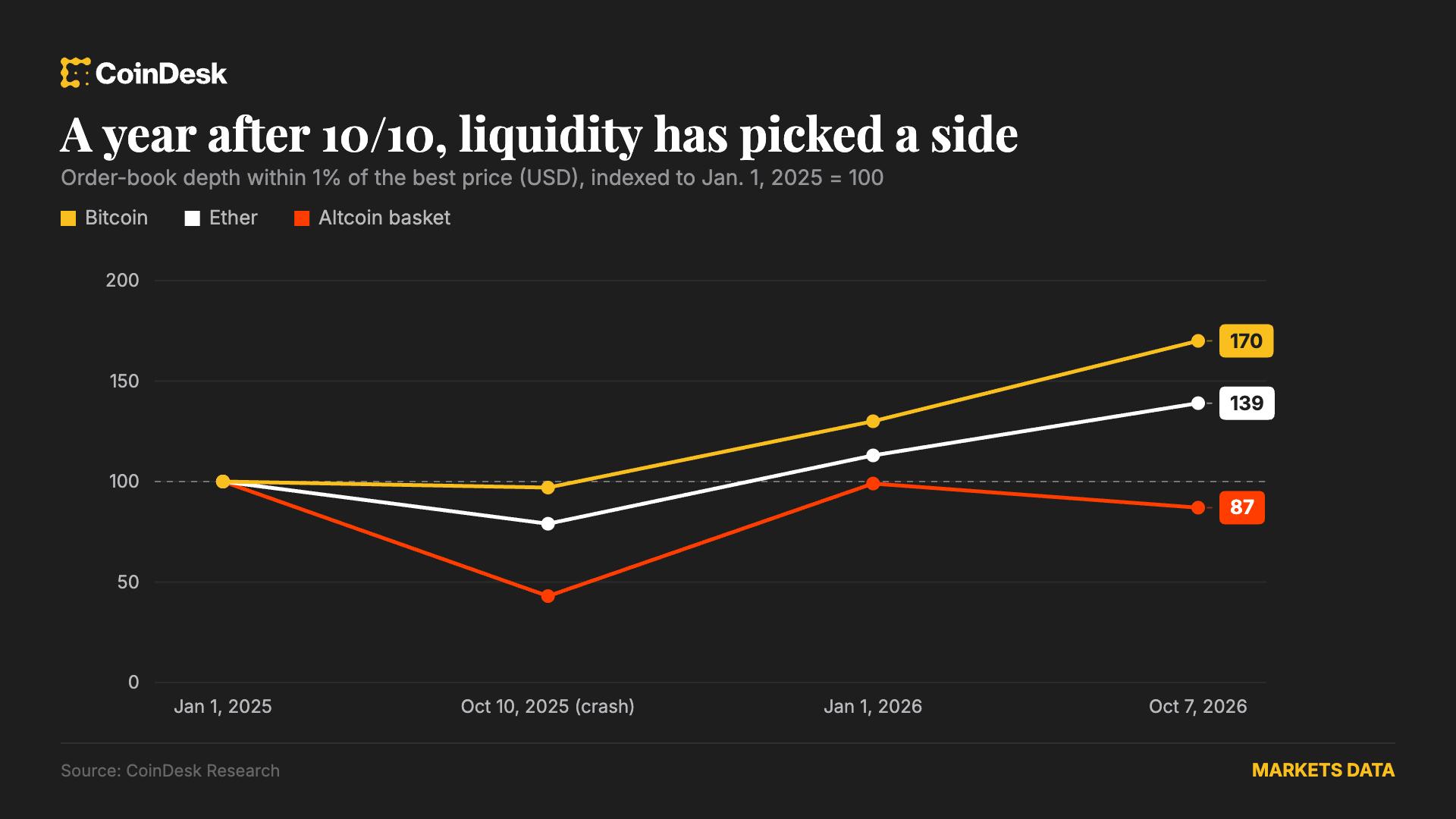
In March 2025, a year after the 10 October flash crash that wiped roughly $19 billion from Bitcoin’s market cap, analysts noted that Bitcoin and Ether had largely rebuilt their liquidity. Their 24‑hour trading volumes returned to pre‑crash levels, and order‑book depth on major exchanges stabilized. However, many altcoins—smaller tokens with lower market caps—still showed thin order books and volatile price swings. This disparity highlighted how larger, more established assets can recover liquidity faster, while niche tokens remain vulnerable to price shocks.
What this means for you
If you aim to earn passive income through crypto, choosing assets with solid liquidity reduces the risk that you cannot move your funds when you need to. For staking or cloud mining, you typically lock a token for a set period; when the lock ends, you’ll want to sell the rewards without hurting the market price. High‑liquidity tokens make that easier.
Conversely, chasing high yields on obscure altcoins can be tempting, but thin liquidity means you may be unable to sell at the advertised price, or you might have to accept a large discount. That can erode or even eliminate the promised earnings.
What to check before you commit
- 24‑hour volume: Look for tokens that consistently trade several million dollars per day on reputable exchanges.
- Order‑book depth: On a CEX, examine the spread between the best bid and ask and the size of orders at those levels. On a DEX, check the total value locked (TVL) in the liquidity pool.
- Exchange coverage: Tokens listed on multiple major exchanges tend to have more robust liquidity.
- Historical stability: Review how the token’s volume and depth behaved during market stress (e.g., previous crashes). Consistent resilience is a good sign.
- Liquidity incentives: Some platforms offer extra rewards for providing liquidity. Weigh those incentives against the risk of impermanent loss (the value change of pooled assets relative to holding them).
FAQ
Why does a token with a high price sometimes have low liquidity?
A high price does not guarantee many buyers or sellers. Liquidity depends on how many participants are willing to trade, not on the token’s absolute value. A token can be expensive but have few holders, leading to thin order books.
Can I improve liquidity for a token I hold?
On decentralized platforms you can add your holdings to a liquidity pool, which increases depth and earns you a share of trading fees. On centralized exchanges, you can place limit orders near the market price to help fill the order book, though this carries execution risk.
Is low liquidity always a red flag?
Not necessarily. Some early‑stage projects intentionally limit supply to control price discovery. However, for earning strategies that require reliable entry and exit, low liquidity adds significant risk and should be approached with caution.
How does liquidity affect staking rewards?
Staking rewards are paid in the same token you lock. If the token is illiquid, you may struggle to sell the rewards at a fair price when the staking period ends, reducing the effective return. Choosing a well‑liquid staking asset helps ensure you can realize your earnings.
This article references reporting from coindesk.com.





