Do you wonder why a central bank’s interest‑rate decision seems to move the price of Bitcoin, even though the cryptocurrency isn’t tied to any government? This article explains how monetary policy affects crypto markets, what the mechanisms are, and how you can think about the impact on your online earnings.
What a Federal Reserve rate hike actually means
The Federal Reserve (the “Fed”) sets the benchmark interest rate, known as the federal funds rate, which is the cost for banks to borrow money overnight. When the Fed raises this rate, borrowing becomes more expensive, consumer spending and business investment tend to slow, and the overall economy cools. The goal is usually to tame inflation, which is the general rise in prices of goods and services.
Higher rates also raise the return on low‑risk assets such as U.S. Treasury bonds and savings accounts. For investors, the choice between a safe, modest return and a riskier asset with higher upside becomes clearer. When safe returns rise, risk‑on assets—stocks, commodities, and cryptocurrencies—often face selling pressure because investors shift money toward the newly more attractive safe options.
Why Bitcoin reacts to interest‑rate news
Bitcoin is classified by many analysts as a “risk‑on” asset. Its price is driven largely by investor sentiment, speculation, and the flow of capital between asset classes. When the Fed announces a rate change, two main forces can affect Bitcoin:
- Opportunity cost. If Treasury yields climb, the relative attractiveness of holding a non‑yield‑bearing asset like Bitcoin drops. Some investors may sell Bitcoin to buy bonds, which now pay a higher return.
- Macro‑risk perception. Rate hikes signal tighter monetary conditions and potentially slower economic growth. In a risk‑off environment, investors often reduce exposure to volatile assets, pushing Bitcoin prices down.
Conversely, if the market expects a rate hike and it arrives as predicted, the impact can be muted. The price may have already priced in the change, leading to a “buy the rumor, sell the news” pattern where the actual announcement causes little movement.
Real‑world illustration: September 2026 Fed decision
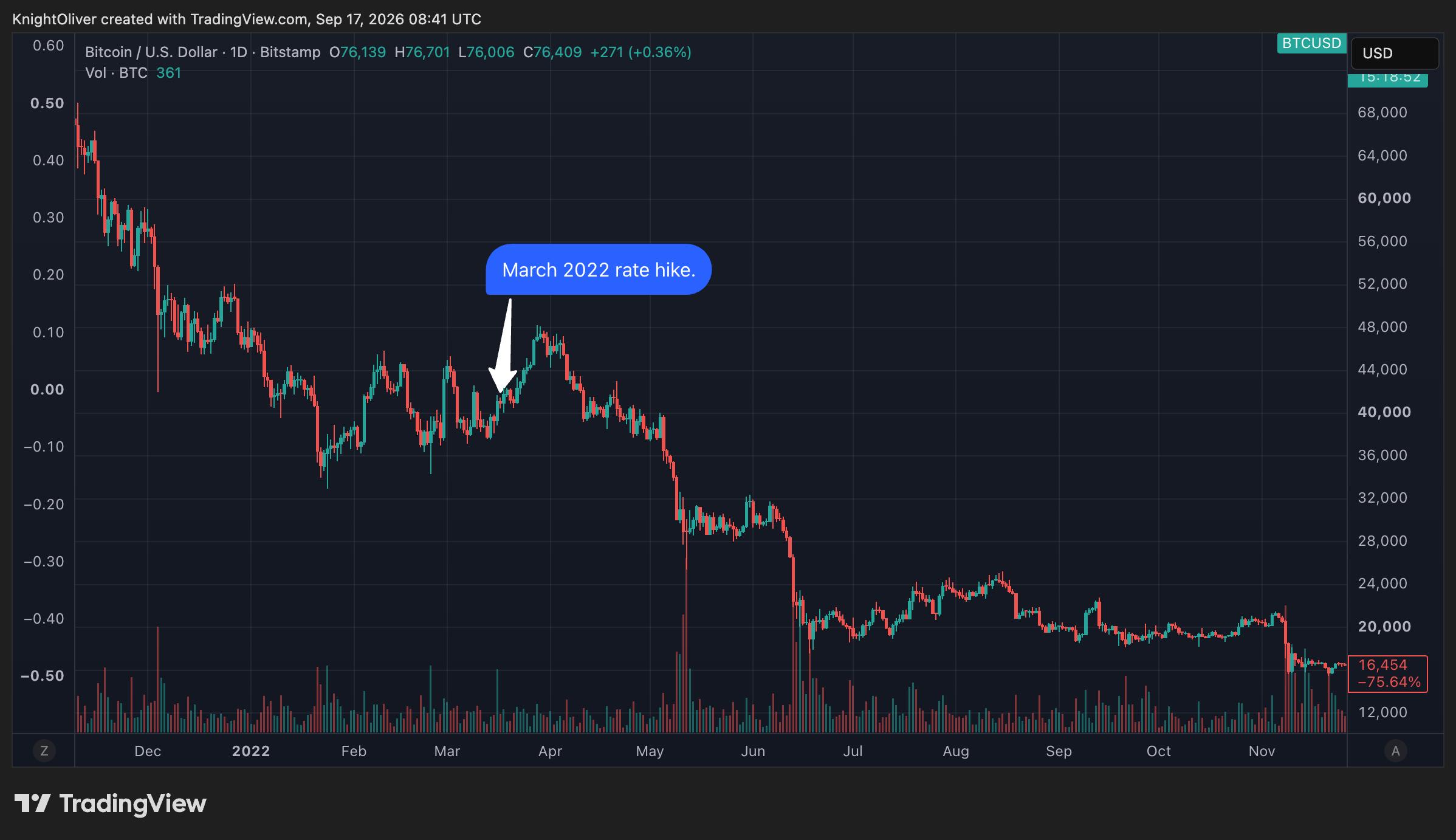
In September 2026, the Federal Open Market Committee voted unanimously to raise the benchmark rate by 25 basis points to a target range of 3.75 %–4 %. This was the first increase since 2023 and came amid persistent inflation. Despite the typical expectation that higher rates would depress risk assets, Bitcoin held near its pre‑announcement level of about $76,000. The price rose 1.35 % over the next 24 hours, indicating that the market had largely anticipated the move.
While the spot price stayed steady, the derivatives market showed a different story. Perpetual futures on Bitcoin shifted toward net selling, with roughly $82 million of short positions opened. At the same time, spot buying added about $15.5 million, suggesting that some traders were buying the actual asset to offset the pressure from futures. Additionally, around 2,170 BTC moved onto exchanges after the announcement, followed by a withdrawal of 1,260 BTC, reflecting active repositioning by investors.
What this means for your online earnings
If you earn passive income through crypto—whether by staking, mining, or providing liquidity—understanding rate‑policy dynamics helps you manage risk. A rate hike can trigger short‑term price volatility, which may affect the value of the rewards you receive. For example, a miner’s daily payout in Bitcoin will be worth less in fiat terms if the price drops after a surprise rate increase.
However, the impact is not always negative. Higher rates can also lead to a weaker U.S. dollar, which sometimes benefits Bitcoin as investors look for assets that are not directly tied to the dollar’s purchasing power. Moreover, if the market expects tightening and the Fed follows through, the price may already reflect the new reality, limiting sudden drops.
How to evaluate the likely impact of a rate change
- Check market expectations. Look at futures contracts and surveys that show what traders think the Fed will do. If the consensus matches the announcement, price reactions are usually muted.
- Watch the yield curve. A steepening curve (long‑term rates rising faster than short‑term rates) can signal expectations of future inflation, which sometimes supports Bitcoin as a hedge.
- Monitor derivatives activity. Large net‑selling in perpetual futures can precede spot price declines, while net‑buying may indicate bullish sentiment.
- Observe exchange flows. Significant inflows of Bitcoin onto exchanges often precede selling pressure, whereas large withdrawals can suggest accumulation.
- Consider your earnings horizon. If you plan to hold rewards for months, short‑term price swings matter less than the overall trend and the security of the platform you use.
FAQ
Q: Will every Fed rate hike push Bitcoin lower?
Not necessarily. If the hike is fully expected, the price may already be priced in. Additionally, other factors—such as geopolitical events or changes in Bitcoin’s own network—can dominate the market response.
Q: How can I protect my crypto earnings from rate‑related volatility?
Consider diversifying across assets (e.g., staking multiple coins) and using stablecoins to lock in value during periods of high volatility. Some platforms also offer hedging tools like futures contracts.
Q: Does a higher Fed rate mean higher Bitcoin mining profitability?
Mining profitability depends on the block reward, transaction fees, electricity costs, and the price of Bitcoin. A higher rate can affect the price, but it does not directly change the cost of electricity or the network’s difficulty.
Q: Should I sell Bitcoin before a scheduled rate decision?
Timing the market is difficult. If you are risk‑averse, you might reduce exposure ahead of a surprise announcement. However, if you believe the market has already priced in the move, holding may be reasonable.
This article references reporting from cointelegraph.com.